Monthly KPI in 30 Minutes—Review Without Stress
TL;DR: Reviewing your monthly KPI should lead to decisions, not stress. This 30-minute KPI review workflow helps wedding professionals turn key performance indicators into clear next steps so marketing actually supports bookings and sustainable growth.

You’re already tracking your numbers.
You’ve got Google Analytics set up. Your CRM is logging inquiries. You probably have a spreadsheet with a few months of data sitting somewhere.
And yet… you still don’t know what any of it actually means.
Here’s the thing nobody really explains. Tracking key performance indicators isn’t the hard part. Figuring out what your KPIs are telling you and knowing what to do next? That’s where most wedding pros get stuck.
I’ve been there. Staring at numbers like “inquiry rate: 2.3%” and thinking… okay, but is that good? Is something broken? What am I even supposed to change?
If that sounds familiar, you’re in the right place.
I’m going to walk you through how to review your monthly KPI in 30 minutes and actually finish with one clear, confident decision every single time. No spiraling. No guessing. Just a repeatable system that fits into real life.
Because here’s the truth: the wedding pros who grow their business consistently aren’t the ones tracking the most data. They’re the ones who know how to look at a few key numbers and actually do something with them.
If you missed Part 1, start there first: Monthly KPI: What Wedding Professionals Need to Track
Here’s what we’re covering:
- What a powerful KPI review system actually looks like (hint: it’s simpler than you think)
- Real KPI performance review examples so you can see what “good” analysis looks like
- The exact 30-minute workflow I use on a monthly basis
- How to understand what your KPIs are telling you so you stop second-guessing yourself
Why Your Monthly KPI Still Feels So Confusing
You followed the advice. You set up the tools. You started tracking the numbers.
And somehow, you still feel stuck.
After working with dozens of wedding professionals, here’s what I know. The issue isn’t that you’re bad at this. It’s that nobody actually showed you how to turn KPI data into decisions.
Looking at metrics without context feels like getting a report card with no explanation. You see a number change and your brain immediately goes “Should I panic? Should I celebrate? What does this even mean?”
So let me give you some context.
This is the Analyze phase of the BODA Framework. You can’t just skip from tracking metrics straight to scaling your business. There’s a middle step where you pause and actually figure out what the data is telling you.
- Build: set up your tools and systems
- Optimize: improve what already exists
- Analyze: review performance and decide what to change ← you’re here
- Achieve: scale with confidence
If you want the full breakdown: BODA Framework overview
The goal here isn’t to track more data. The goal is to decide faster so you can actually grow your wedding business instead of just collecting numbers that sit in a spreadsheet.
Why Most KPI Advice Doesn’t Work for Wedding Professionals
Okay, here’s something that took me way too long to figure out.
Most KPI advice out there? It’s written for SaaS companies, ecommerce brands, or businesses with full marketing teams. Wedding professionals operate completely differently.
Your sales cycle is seasonal. Your leads are emotional, not transactional. Your marketing channels span search, social, referrals, directories, and now AI-driven discovery. And most importantly? Your time is incredibly limited.
Generic advice like “track everything weekly” completely ignores wedding weekends, client work, and creative burnout. And those benchmark conversion rates you see online? They rarely account for custom proposals, high-touch sales, or luxury pricing.
A powerful KPI review system for wedding pros needs to account for:
- Seasonality and booking cycles (because January will never look like October)
- Long decision timelines (couples don’t book on impulse)
- The difference between interest and actual readiness to book
- Capacity limits and burnout risk (you can’t just “scale” infinitely)
So if you’ve felt like the standard business advice doesn’t quite fit? You’re not wrong. The framework you were given just wasn’t designed for how wedding businesses actually work.
Start With Goals, Not Metrics
If someone’s up at 2am Googling “how to review KPIs,” it’s usually because they’re trying to answer one question: is my marketing actually working?
Here’s the order that keeps things from getting chaotic:
- Define your business goal first
- Create a simple marketing plan that supports it
- Track monthly KPIs that confirm whether the plan is working
Without a goal, it’s way too easy to just default to whatever metrics your platforms show you. Followers, likes, reach… they look impressive, but do they actually help you make decisions? Usually not.
Instead, pick one clear goal for the next 90 days. And I mean specific.
Not “grow my business” but “book 6 weddings by March 31.” Not “get more inquiries” but “get 30 qualified inquiries this quarter.”
Then figure out which KPIs actually support that goal. If bookings are what you’re after, track inquiry rate and inquiry-to-booking conversion. If you want higher-value bookings, track average booking value and where your best clients are coming from.
If you want a practical example, this guide walks through how to build a wedding business marketing plan that actually books clients.
And hey, while we’re at it—HubSpot has a great piece on vanity metrics and why they look impressive but don’t actually guide decisions. Worth a read if you’ve ever wondered whether your Instagram followers actually matter. (Spoiler: probably not as much as you think.)
How Your Monthly KPIs Connect to Actual Bookings
Here’s a simple way to think about it.
A marketing plan outlines what you intend to do. KPIs tell you whether it’s working.
Without KPIs, your plan is just guesswork. Without a plan, your KPIs are just noise.
Monthly KPI reviews are the bridge between intention and outcome.
So like, let’s say your plan focuses on blogging and Pinterest. Your KPIs show whether traffic is actually growing, which content converts, and where your inquiries are coming from. And your review tells you whether to stay the course or adjust.
That feedback loop is everything. It prevents wasted effort and builds confidence in your decisions. Because you’re not just hoping anymore—you’re actually seeing what’s working.
How to Turn Your Monthly KPI Into a Clear Decision
Okay, this is where most people freeze up.
They see a number change and immediately jump to Googling benchmarks for 45 minutes or questioning their entire business strategy. I’ve done it. It’s not fun.
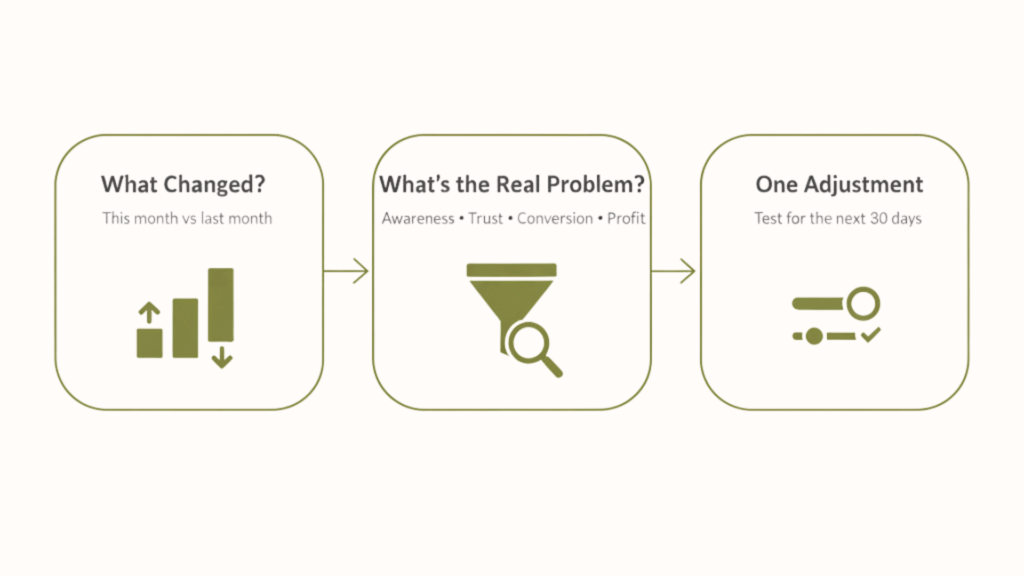
Here’s a simpler approach. Three steps.
Step 1: What actually changed?
Compare this month to last month. Did the KPI go up, down, or stay the same? Focus on the actual number, not how it feels. Not “it seems like fewer inquiries” but the real data.
This sounds obvious but I can’t tell you how many times I’ve talked to someone who “felt” like things were slow, and when we actually looked at the numbers, they were up 15% from last month. Our brains lie to us. The data doesn’t.
Step 2: Name the real problem.
Almost every KPI issue fits into one of four buckets:
- Awareness problem — not enough people are seeing you
- Trust problem — people see you but don’t engage or inquire
- Conversion problem — people engage but don’t book
- Profit problem — you’re booking clients but the math doesn’t work
That’s it. You’re not solving 47 different problems. You’re solving one of these four.
Step 3: Pick one thing to change.
One lever. Not five. When you try to fix everything at once, you fix nothing. But when you focus on one thing for a month, you actually see results.
Let me show you what this looks like in real life.
KPI Performance Review Examples
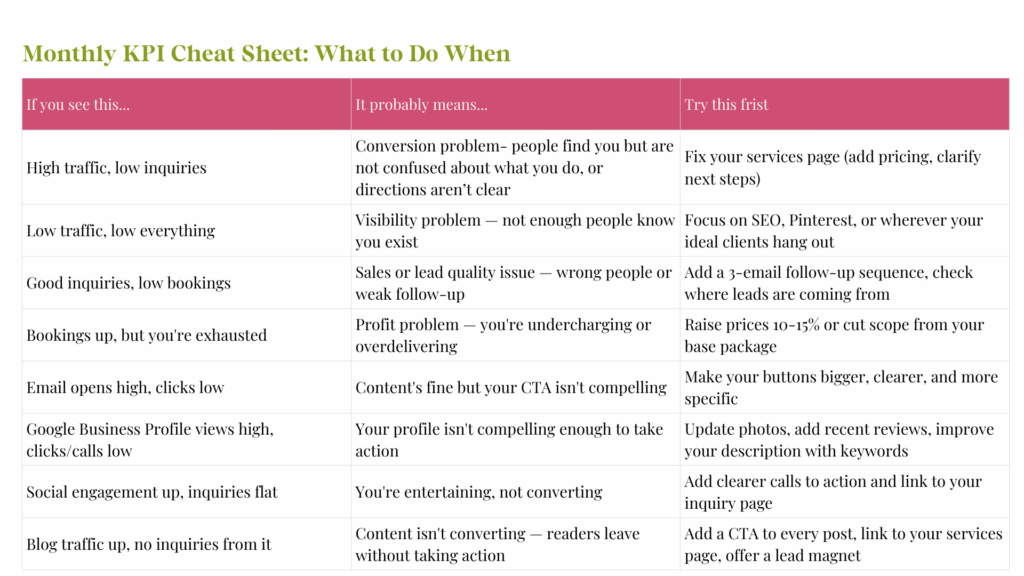
Example 1: High Website Traffic, Low Inquiries
The numbers: Last month you had 800 website visitors and 18 inquiries (2.25% inquiry rate). This month you had 1,200 visitors but only 19 inquiries (1.58% inquiry rate).
What’s actually happening: Traffic is up 50% but inquiries barely moved. Your inquiry rate actually dropped. This is a conversion problem, not a visibility problem. People are finding you—they’re just not reaching out once they get there.
What I’d do: Don’t chase more traffic yet. That’s not the leak. Fix your website conversion first. Is your contact form easy to find? Is your pricing guidance clear enough that people know if they can afford you? Does your services page actually explain what you do?
One thing to try: Rewrite your services page to include starting pricing and a clear “what happens next” section. Test it for 30 days and see if your inquiry rate improves.
Example 2: Strong Inquiries, Weak Bookings
The numbers: Last month you had 15 inquiries and 7 bookings (47% conversion). This month you had 22 inquiries but only 4 bookings (18% conversion).
What’s actually happening: More inquiries but way fewer bookings. This is either a sales process problem or a lead quality problem. More inquiries isn’t always better if they’re not the right people.
What I’d do: Look at where these new inquiries came from. If you ran an ad or got featured somewhere new, you might be attracting people who aren’t actually your ideal client. They’re curious but not qualified. Or maybe your follow-up needs work—are you responding within a couple hours? Following up more than once?
One thing to try: Set up a simple 3-email follow-up sequence for inquiries who don’t book right away. Most people need 3-5 touchpoints before they’re ready to commit.
Example 3: Business Growth With Burnout
The numbers: Bookings are up 40%. Revenue is up 35%. But hours worked? Up 60%.
What’s actually happening: You’re “growing” on paper. But it’s not sustainable. This is a profit problem disguised as success. You’re working way more but not earning proportionally more. Your effective hourly rate is actually going down.
What I’d do: Calculate your real hourly rate—total revenue divided by total hours worked. If you’re making less per hour this year than last year despite “growing,” something needs to change.
One thing to try: Raise prices by 15% for new inquiries. Or cut scope from your base package so you’re working fewer hours per client. Pick one, not both.
See how this works? Your KPIs are just feedback. They’re showing you where to focus, not judging whether you’re good at business.
The 30-Minute Monthly KPI Review Workflow
If your KPI review takes two hours, it’s not gonna happen consistently. That’s not a motivation problem—that’s a design problem.
I used to block entire afternoons for this stuff. I’d open 15 browser tabs, pull reports from five different platforms, copy everything into spreadsheets. By the time I finished gathering the data, I was too fried to actually think about what it meant. So I’d close my laptop and tell myself I’d “figure it out later.”
Spoiler: I never figured it out later.
That’s when I realized the monthly review doesn’t need to be a project. It needs to be a rhythm. Something you can knock out while your coffee’s still hot.
Here’s how I do it now:
Health Check (5 minutes)
Before you look at any performance numbers, make sure nothing is actively broken.
- Does your contact form actually submit? (Test it yourself right now)
- Do your Instagram bio and email signature links still work?
- Is your scheduler accepting bookings?
- Are your auto-reply emails sending?
I’ve watched wedding pros panic about “no inquiries this week” only to discover their contact form broke three days ago and they had no idea. Always check the basics first.
Performance Review (15 minutes)
Pull your monthly KPI shortlist. Not everything—just the 5-7 numbers that actually guide decisions.
- Website visitors and inquiry rate
- Number of inquiries and booking conversion
- Where inquiries came from (your top 3 sources)
- Email open and click rates
- Social saves, profile visits, DMs
Write down what changed compared to last month. Don’t analyze yet—just record.
If your data already lives in one place (a simple dashboard in Notion or Google Sheets), this takes 10 minutes instead of 45.
Strategy Shift (10 minutes)
Look at your numbers and ask: what’s the real problem here?
Pick one thing to continue (it’s working, keep going), adjust (close but needs a tweak), or stop (not moving the needle).
Write it down somewhere you’ll actually see it:
Focus for next month: Improve website conversion One thing I’ll do this week: Rewrite services page with clearer pricing
That’s it. Put this 30-minute review on your calendar for the same day each month. Consistency beats intensity every single time.
Why Reviews Break Down (And How to Fix It)
Most monthly reviews fall apart because of one of these three things:
- Data lives in too many tools and there’s no central hub, so just starting the review feels exhausting
- There’s no decision log, so you forget what you changed and why—and you can’t learn from patterns
- It’s not scheduled, so it keeps getting pushed to “next week” which turns into next month
The fix is simpler than you think. One dashboard where your numbers live. One document where you track your decisions. One recurring calendar event that you treat like a client meeting.
That’s what makes the system actually repeatable. And repeatable is what gets results.
What About Seasonality?
A wedding planner told me last year, “January feels like failure every single year.”
Her inquiry numbers dropped 60% compared to December. Social engagement tanked. Email opens dipped. She started questioning whether her entire marketing plan was broken.
Then we compared January 2025 to January 2024. She’d actually grown 22% year-over-year. It was her best January ever.
But because she was comparing it to December—peak season—it felt like everything was falling apart.
Here’s the thing: month-to-month comparisons can be super misleading in the wedding industry. Comparing January to December is like comparing winter to summer and wondering why it’s colder outside.
Instead, compare year-over-year (this January vs. last January). Look at trends over 90 days instead of freaking out about one slow month. And add context notes to every review so you remember what was different—”launched new package,” “took two weeks off,” “got featured in a blog,” “ran Pinterest ads for the first time.”
Those notes will save you so much confusion later. Otherwise you’ll stare at a random spike in March and have absolutely no idea what caused it or how to repeat it.
Your slowest month should still show growth compared to last year’s slowest month. That’s the number that actually matters.

One More Thing: AI Is Changing How Couples Find You
This is worth mentioning because it’s shifting some patterns.
AI-powered search and automation are changing how couples discover vendors. You might notice fewer but more qualified inquiries, longer decision timelines, new traffic sources you’ve never seen before, or inquiries coming in at weird hours.
If you want to dig deeper:
- Wedding Business Marketing with AI Tools for Sustainable Growth
- AI for wedding professionals
- Is an AI Marketing Assistant Just What You’re Looking For?
Monthly KPI reviews help you spot these shifts early so you can adapt instead of panic.
Want the Workflow I Just Walked You Through?
I turned this whole process into a simple checklist you can use every month:
- The 30-minute workflow broken into steps
- A monthly KPI dashboard template
- Decision prompts to figure out what each metric means
- Space for your one focus for next month
Download the Monthly Marketing Systems Checklist
Final Thoughts
Your KPIs aren’t a test you pass or fail. They’re not a report card judging whether you’re “good enough” at business. They’re just feedback. A GPS showing you where to turn next.
You don’t need to be a “numbers person” to do this well. Honestly? I barely passed algebra in college. I used to avoid spreadsheets like they personally offended me. But now I can look at five metrics and know exactly what to do next. That’s not because I got smarter—it’s because I built a system.
The wedding professionals who grow consistently aren’t tracking more metrics than everyone else. They’re reviewing the right metrics on a monthly basis, making one clear decision, and actually following through on it.
That’s really all it takes.
Simple beats perfect. Every time.