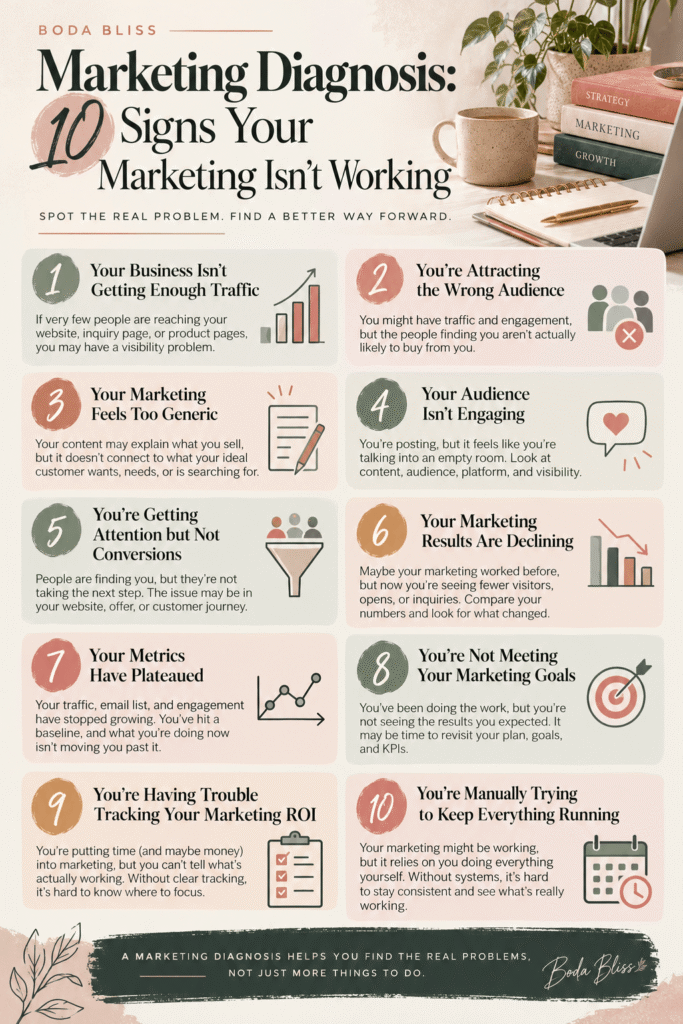
Marketing Diagnosis: 10 Signs Your Marketing Isn’t Working
TLDR: A marketing diagnosis shows why your marketing isn’t working, where customers get stuck, and what to fix before adding another tactic or campaign.

Have you ever looked back at a month of marketing and wondered what went wrong? You put in the effort, tried new ideas, posted consistently, and still saw little change.
A marketing diagnosis is a research-based review that finds out why your marketing isn’t producing results: where people find you, where they get stuck, and what’s actually worth fixing. Think of it as figuring out the real problem before you add another campaign, platform, promotion, or plan.
The good news? There are still three months left in 2026, and that’s plenty of time to make a real change.
But this is also the time of year when it’s tempting to pile more onto your plate.
Black Friday is coming. Holiday campaigns are starting. You’re thinking about what needs to happen before the end of the year while also beginning to plan for 2027.
And when results slow down, it’s easy to assume the answer is more.
More posts. More emails. More platforms. More promotions.
Before you add any of them, try asking a different question:
Do you know what’s actually not working?
That’s where a marketing diagnosis comes in. It gives you a chance to stop guessing, look at what’s really happening, and figure out where your energy should go next.
What Are the Warning Signs Your Marketing Isn’t Working?
Marketing problems don’t always look dramatic.
Sometimes there isn’t one obvious moment when everything stops working. Instead, you start noticing little signs that something is off.
Maybe traffic has slowly declined. You’re creating content but engagement has flattened. People visit your website but don’t inquire. Or you’re spending more time on marketing without seeing a meaningful change in results.
Here’s what makes this tricky:
Visibility problems and conversion problems can feel the same from the inside.
Both can show up as slow sales or a quiet inbox. However, they need very different fixes.
That’s why I’ve put these ten signs in the order your customers experience them: first finding you, next becoming a customer, and finally how you track and manage the marketing behind it all.
Sign 1: Your Business Isn’t Getting Enough Traffic
Start at the beginning: can people find you?
If very few people are reaching your website, inquiry page, product pages, or other important parts of your business, you may have a visibility problem.
When I see this, I start with search visibility, keywords, Google Business Profile, referral traffic, social platforms, and how your content leads people back to your business.
For example, Google’s Search Console Performance report lets you compare search impressions, clicks, click-through rate, and average position over time. It’s an easy way to see whether more people are finding you in search, fewer people are, or nothing’s really changing.
If you run a local business, your Google Business Profile performance shows things like website clicks and direction requests, so you can see what people actually do after they find you.
The goal isn’t traffic for traffic’s sake.
You need the right people finding the right pages.
Related: AI Search Visibility Post
Sign 2: You’re Attracting the Wrong Audience
Traffic and engagement can look good on paper and still not produce results.
You might have people reading your posts, visiting your website, or following your accounts who aren’t actually likely to buy from you.
For instance, a post might get lots of likes and comments but not send a single right-fit person to your website. It looks great, but it isn’t moving your business forward.
That’s why I don’t judge marketing success by visibility alone.
You also need to know who you’re becoming visible to and what they do next.
A marketing diagnosis looks past how much attention you’re getting and asks a better question: is it coming from the right people?
Sign 3: Your Marketing Feels Too Generic
Sometimes the problem isn’t how often you’re marketing. It’s what you’re saying.
Your content might explain what you sell without connecting it to what your ideal customer wants, needs, worries about, or is searching for.
This matters a lot for indie authors, booksellers, and creative businesses. People aren’t only responding to a book, product, or service. They’re responding to the story, experience, problem, or desire surrounding it.
For example, an indie bookstore sells many of the same books people can find elsewhere. So its marketing gives people a different reason to visit: finding unusual books, meeting other readers, going to local events, or having a neighborhood spot where book people belong.
If that connection is missing, making more of the same content probably won’t fix it.
Sign 4: Your Audience Isn’t Engaging
You’re publishing content, but it feels like you’re talking into an empty room.
Before you decide to post more often, take a closer look at the content itself.
Are you answering questions your audience actually has?
Are you talking about problems they recognize?
Does your content give them a reason to respond, click, save, share, or keep reading?
And just as important: are you showing up where your audience actually hangs out?
Low engagement can be a content problem, but it can also point to an audience, platform, positioning, or visibility problem.
So instead of automatically posting more, treat the quiet as a clue.
Sign 5: You’re Getting Attention but Not Conversions
Next, let’s move further along the customer journey.
People are finding you. They’re visiting your website. Maybe they’re opening your emails or interacting with your content.
But they’re not taking the next step.
This is where “I need more traffic” can send you in the wrong direction.
If the people already visiting aren’t taking action, sending more people through the same experience probably won’t fix it.
For instance, picture a florist getting plenty of Instagram profile visits before wedding season but very few consultation inquiries. The issue may not be visibility at all. Their service info could be hard to find, their inquiry form might have too many steps, or couples might not know what happens after they reach out.
A marketing diagnosis helps you find the exact spot where people stop moving forward.
Google Analytics’ Funnel Exploration report shows the steps people take toward an action, like filling out an inquiry form, and where they drop off.
That’s how you tell a traffic problem apart from a conversion problem.
Sign 6: Your Marketing Results Are Declining
Maybe your marketing worked before, but the results have started slipping.
First, compare where you are now with three or six months ago.
Are fewer people visiting your website? Have inquiries slowed down? Are fewer people opening your emails, finding you through search, or interacting with your content?
One slow week doesn’t mean something’s wrong. However, a steady decline is worth a closer look.
Instead of immediately asking, “How do I get my numbers back up?”, start with:
What changed?
Maybe your search traffic dropped. Or a platform that used to send people your way isn’t doing that anymore. Your audience’s habits might have shifted, too.
Finding the reason matters because each one needs a different fix.
Sign 7: Your Metrics Have Plateaued
Not every marketing problem looks like declining numbers.
Sometimes everything simply stops growing.
Your website traffic stays around the same level. Your email list barely moves. Engagement remains flat. Inquiries arrive at roughly the same inconsistent pace.
You’ve hit a baseline, and what you’re doing now isn’t moving you past it.
That’s actually useful information.
So instead of doing more, look at what’s creating the ceiling.
A marketing diagnosis can also help you tell the difference between marketing that’s steady and sustainable and marketing that’s simply stopped growing.
Sign 8: You’re Not Meeting Your Marketing Goals
This sounds obvious, but it’s easy to overlook when you’re busy doing the work.
Start by going back to the goals you set for your marketing.
Did you want more inquiries? More book sales? More local visibility? More email subscribers? More qualified website traffic?
Next, compare those goals with what actually happened.
If you’ve been following your plan but aren’t getting closer to what it was supposed to do, the plan itself may need to change.
This is also why your marketing goals and marketing KPIs need to connect. A number going up doesn’t always mean you’re closer to the result your business needs.
Related: Marketing KPIs Post
Sign 9: You’re Having Trouble Tracking Your Marketing ROI
You know you’re putting time (and maybe money) into marketing, but you can’t say for sure what’s working.
Which channels bring people to your website?
What content gets people interested?
Where do inquiries come from?
Which marketing activities actually contribute to a sale, booking, or inquiry?
If you can’t answer those, it’s really hard to know where your time should go.
Looking at your tools together helps a lot here. Google explains how Search Console and Google Analytics each show a different piece of the picture. Search Console shows how you’re doing in Google Search before someone clicks, while Analytics shows what they do once they land on your site.
That’s why a marketing diagnosis doesn’t look at each number on its own. Instead, it connects what you’re doing with what happens next.
For example, a post with fewer likes that keeps sending right-fit people to your website may be worth more than a post with tons of likes that leads nowhere.
The numbers need context.
Sign 10: You’re Manually Trying to Keep Everything Running
Finally, look at what it takes to keep your marketing going.
Your marketing might technically be working, but keeping it going means you have to remember, create, publish, track, follow up on, and manage everything yourself.
That’s still a warning sign.
When you’re the one holding every piece together, it gets harder to stay consistent, keep track of what’s happening, and see what’s actually working.
So before you add another platform or campaign, it may be time to simplify and systemize what you already have.
You don’t need to automate everything. You just need enough structure that you’re not reinventing the process every single week.

Marketing Audit vs. Marketing Diagnosis: What’s the Difference?
A marketing audit and a marketing diagnosis overlap a bit, but they answer different questions.
A marketing audit looks at what you have, what you’re doing, and whether the important pieces are in place.
A marketing diagnosis goes a step further. It asks why you’re getting the results you’re getting and what to do about it.
An audit might uncover:
Your website traffic is down.
A diagnosis asks:
Why is traffic down? Where did it previously come from? What changed? What should you do about it?
Or an audit might identify:
Your content isn’t converting.
A diagnosis looks for where people are dropping off between discovering the content and becoming a customer.
The point isn’t to find everything that could be better.
It’s to find the problems that actually matter and decide what to tackle first.
What Does a Marketing Diagnosis Look At?

Marketing doesn’t happen one platform at a time, even if that’s how we tend to manage it.
Someone might discover you on Google, read three pages of your website, disappear for a week, see something you posted on Instagram, join your email list, and finally inquire.
That’s why I don’t look at your website over here, your content over there, and your Google Business Profile somewhere else.
I want to know how someone moves through all of it.
For my Marketing Diagnostic, that means looking at:
- Your website and important pages
- Search visibility
- Google Business Profile
- Social channels and content
- Competitors
- Keywords and search opportunities
- Customer journey
- The path from content to inquiry or purchase
Next, I look at how those pieces connect.
- Where are people finding you?
- What pages and content are getting noticed?
- Where is visibility getting stuck?
- Does your messaging connect with the audience you’re trying to reach?
- What happens after someone discovers your business?
- Where does the path from content to inquiry start breaking down?
Most importantly, what should you actually focus on next?
This is where working with a marketing strategist really helps. I’m not grading each channel on its own. I’m looking for the one or two changes that will make the biggest difference across all of them.
Making a Shift in Your Marketing Before the Next Quarter
Whether you’re heading into Q1, Q4, or any new quarter, it’s easy to jump straight into planning what you’re going to do next.
New campaigns. New content. New goals. Maybe even a new platform.
But before adding more to your marketing plan, it’s worth looking at what’s already happening.
A marketing diagnosis can show you whether your next campaign is really the best use of your time.
If your website isn’t converting, another campaign may not fix it.
If people can’t find you in search, posting more on a platform with limited reach may not fix it.
If your messaging isn’t reaching the right people, creating more content may just spread the wrong message further.
And if people find you but disappear before they inquire or buy, it’s worth finding that gap before sending even more people down the same path.
A new quarter gives you three months to work with. That’s enough time to identify what’s happening, make a few intentional changes, watch how they perform, and use what you learn to make better marketing decisions in the next quarter.
Before you build another list of things you think you should be doing, figure out what actually needs your attention.
Related: Quarterly Marketing Planning Post
Frequently Asked Questions About Marketing Diagnosis
Also known as a marketing audit or marketing review, a marketing diagnosis looks at all the ways you market your services or products to find where you might be having an issue. Think of it like an annual physical for your marketing: you’re checking what’s working, what isn’t, and what may need attention.
Not always.You can spot a lot of marketing problems yourself by regularly checking your numbers, customer journey, messaging, and results.
However, a marketing strategist can help when you need to see how all the pieces work together.
Start with the goal your marketing is supposed to achieve, then look at the numbers connected to that goal. More traffic, followers, or engagement can be good signs, but they only matter if they’re helping move your business toward more inquiries, sales, bookings, subscribers, or whatever result you’re trying to create.
Any business can benefit from a marketing diagnosis, but it’s especially helpful for small businesses, creative businesses, and authors with limited time and resources. It helps make sure the marketing you’re already doing is worth your time before you spend more money, add another platform, or create more work for yourself.
Find Out What’s Working Before You Add More
You don’t need to overhaul your entire marketing strategy just because something isn’t working.
Sometimes you need to figure out where the problem actually is first.
That’s what my $750 Marketing Diagnostic is for. I’ll investigate your website, visibility, content, competitors, keywords, search presence, and customer journey to find what’s working, what’s getting stuck, and what deserves your attention first.
You’ll leave with a prioritized action plan for the first 30 days, next 90 days, and next 6–12 months, plus a 60-minute strategy review where we’ll walk through the findings together.
Learn More About the Marketing Diagnostic →