Getting Started with Enji: Build a Marketing System
This blog was originally published earlier and updated on June 24, 2025, to reflect the latest Enji features and marketing insights.
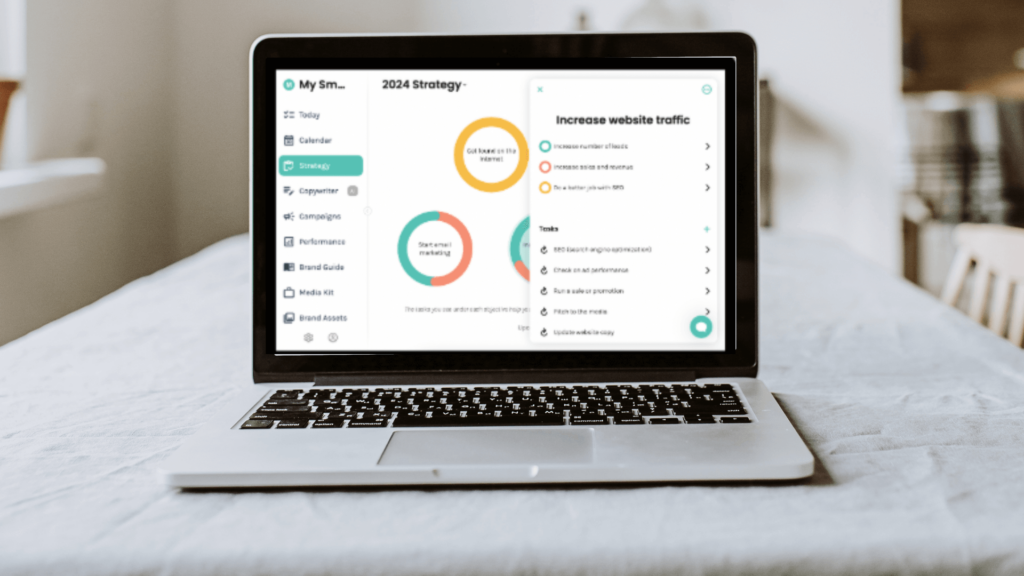
Getting Started with Enji can feel a little overwhelming. Opening a new marketing project management tool for the first time often leaves you wondering, “Where do I even begin?”
Between setting goals, organizing campaigns, and learning new features, it’s easy to feel like you need to master everything at once.
The good news is that Enji makes the setup process surprisingly simple by guiding you step by step. However, I’ve learned that successful marketing isn’t just about learning new software. It’s about building a marketing system that supports the way you work.
When I first tried Enji, I wasn’t ready for it. I expected it to work like a traditional project management platform, and I quickly became overwhelmed. A few years later, I decided to give it another chance. This time, I approached it differently. Instead of focusing on tasks, I focused on creating a repeatable marketing system, and that’s when everything clicked.
Whether you’re a photographer, bookstore owner, florist, designer, stationery shop, wedding professional, or another creative business owner, the same principle applies: the right software is only as effective as the system behind it.
In this blog, you’ll learn:
- How to avoid the most common mistakes new Enji users make
- Getting started with Enji step by step
- How to organize your marketing campaigns and content
- Which integrations to connect first
- How to build a marketing system you’ll actually use
- When it makes sense to get expert help setting up Enji
By the end of this guide, you’ll have a clear plan for turning Enji into the marketing headquarters for your creative business.
Why Most Marketing Software Doesn’t Stick
If you’ve ever signed up for a new software platform with the best intentions only to stop using it a few weeks later, you’re not alone.
The problem usually isn’t the software. It’s that your marketing is competing with every other part of your business for your attention.
For years, I used Asana as my operational hub. It managed everything from client projects and bookkeeping to CEO tasks and marketing. While it kept everything in one place, it also became my biggest distraction.
As someone with ADHD, having every task in one workspace meant I was constantly switching gears. I’d sit down to work on my marketing, see a bookkeeping reminder or an overdue client task, and suddenly my marketing was pushed to “tomorrow.” Unfortunately, tomorrow often became next week.
That’s why Enji completely changed the way I approach marketing.
Unlike an all-in-one project management platform, Enji has one purpose: Marketing.
It isn’t a CRM or an email marketing platform like Flodesk. It isn’t trying to manage every aspect of your business. Instead, it’s a dedicated marketing project management tool designed to help you plan, organize, and execute your marketing strategy without competing priorities pulling you in different directions.
As a result, I finally gave my marketing its own dedicated home, and that made all the difference.
If you’re still deciding whether Enji is the right fit for your business, be sure to read my Enji Review, where I share my experience after using it for several years and explain why it has become the marketing headquarters for my business.
Common Mistakes New Enji Users Make
Although Enji is easy to set up, there are a few common mistakes that can keep creative business owners from getting the most out of it.
Expecting Enji to Be a “Set It and Forget It” Tool
One of the biggest misconceptions is thinking Enji will magically market your business for you.
Like any marketing system, Enji works best when you consistently engage with it. It helps you organize your strategy, plan campaigns, and stay accountable, but it still requires your creativity and expertise.
Trying to Learn Every Feature in One Day
When you first log in, it’s tempting to explore every feature at once.
Instead, focus on what you need today. Start with your goals, create your first campaign, and begin planning your content. Once you’re comfortable, you can gradually explore the additional features.
Keeping Your Marketing in Multiple Places
This is probably the biggest mistake I see.
Many business owners buy Enji but continue using a separate marketing calendar, another spreadsheet for ideas, sticky notes for campaigns, and a paper planner for deadlines.
As a result, they’re constantly wondering which version is the most up to date.
The more your marketing is scattered across different tools, the harder it becomes to stay consistent.
Whenever possible, let Enji become your marketing headquarters.
Giving Up on Enji Too Soon
Finally, don’t expect perfection during your first week.
Every new system has a learning curve. However, once you establish a routine and begin using Enji consistently, it becomes much easier to see how everything connects.
Remember, you’re not just learning a new piece of software. You’re building a marketing system that supports your creative business for years to come.
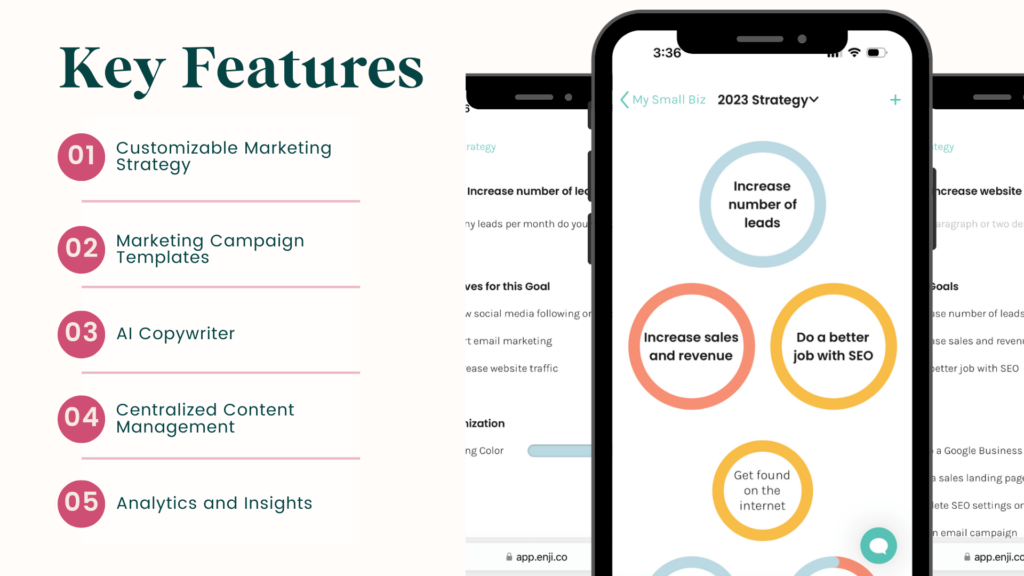
Getting Started with Enji: Step-by-Step Setup Guide
Now that you understand why marketing software often gets abandoned, it’s time to build a system that actually lasts.
Fortunately, getting started with Enji is a straightforward process. The platform guides you through each step, making it easy to create a marketing system that fits your business instead of forcing you into someone else’s workflow.
Before you begin, I encourage you to spend a little time thinking about your marketing as a whole. Ask yourself questions like:
- What are my biggest marketing goals this year?
- Which marketing channels actually bring in clients?
- What products or services do I want to promote?
- Do I already have a consistent brand voice?
- Is my content organized, or is it scattered across notebooks, spreadsheets, and sticky notes?
If those questions feel difficult to answer, don’t worry. That’s exactly why I created my Marketing Systems Audit. Before investing time setting up new software, the audit helps you identify what’s working, where your marketing gaps are, and which systems need attention first. Starting with clarity makes every step inside Enji much easier.
Once you have a general direction, you’re ready to start building.
Step 1: Complete the Business Quiz
First, create your Enji account and complete the business questionnaire.
Although it only takes a few minutes, this step lays the foundation for your entire marketing system. Enji asks about your business, audience, services, and goals so it can recommend marketing activities that are relevant to you.
Instead of starting with a blank workspace, you’ll receive a personalized roadmap designed around your business.
Pro Tip: Answer the questions honestly based on where your business is today, not where you hope it will be next year. Your strategy should support your current stage of growth.
Step 2: Set Your Marketing Goals
Next, choose up to three marketing goals.
Rather than trying to improve everything at once, focus on the outcomes that will have the biggest impact on your business.
For example, your goals might include:
- Increase website traffic
- Book more discovery calls
- Grow your email list
- Launch a new product or service
- Improve customer retention
Your goals will guide every campaign and marketing task you create inside Enji.
Step 3: Choose Your Marketing Channels
Once your goals are in place, tell Enji where you want to focus your marketing efforts.
You don’t have to be everywhere.
Instead, choose the channels that make the most sense for your creative business, such as:
- Email Marketing
- SEO
- Google Business Profile
By narrowing your focus, Enji can recommend marketing activities that support your overall strategy instead of creating unnecessary work.
Step 4: Build Your Marketing Roadmap
Now the fun begins.
Based on your goals and marketing channels, Enji automatically generates a prioritized marketing roadmap complete with recommended tasks and suggested due dates.
Rather than asking yourself, “What should I work on today?” you’ll always have a clear next step.
This is one of the biggest reasons I continue using Enji.
Step 5: Upload Your Brand Assets
Before creating content, upload your brand assets.
This includes:
- Logo files
- Brand colors
- Fonts
- Brand messaging
- Photos
- Brand guidelines
As a result, your marketing stays more consistent, and Enji’s AI tools have the context they need to generate content that sounds more like you.
Step 6: Connect Your Favorite Tools
Next, connect the platforms you already use.
Depending on your business, this may include:
- Canva
- Google Analytics 4
- TikTok
- Threads
Connecting these tools transforms Enji into the central hub for your marketing activities.
Step 7: Launch Your First Campaign
Rather than creating random marketing tasks, start with a campaign.
One of my favorite features inside Enji is its marketing campaign templates. Instead of staring at a blank screen, you can choose from ready-made campaigns like SEO, email list building, product launches, seasonal promotions, events, PR, and service promotions. Simply choose a template, select a start date, and Enji automatically builds a timeline with recommended tasks, due dates, and suggested metrics to track your progress.
Example Campaign: Launching a New Service
Let’s imagine you’re a creative business owner launching a new service.
Campaign Goal: Book five new clients within 30 days.
Select Campaign Length: Two weeks of planning followed by a two-week launch.
Your Enji Campaign Might Include:
Prepare: Week 1
- Finalize your service details and pricing.
- Update your website sales page.
- Create branded graphics in Canva.
- Write an announcement email.
- Draft your blog post.
- Schedule social media content.
- Prepare Pinterest graphics.
Build Excitement: Week 2
- Publish a teaser on Instagram and Facebook.
- Send your announcement email.
- Publish your blog post.
- Pin your new content to Pinterest.
- Update your Google Business Profile.
- Reach out to referral partners.
- Schedule reminder posts.
Launch: Week 3
- Officially announce the new service.
- Share client testimonials.
- Answer questions on social media.
- Monitor website traffic and inquiries.
- Continue promoting across your marketing channels.
Review: Week 4
- Check your website traffic.
- Review email open and click rates.
- Measure inquiries and bookings.
- Compare your results against your original goal.
- Make notes for your next campaign.
Why Campaigns Work
Instead of asking yourself, “What should I post today?” you’ll already have a complete marketing plan waiting for you.
That’s one of the biggest differences between checking random marketing tasks off a list and building a true marketing system. Every blog post, email, Pinterest Pin, and social media post works together toward one measurable goal.
This is exactly why I recommend using Enji’s campaign templates. They remove the guesswork by providing a structured plan, recommended tasks, and metrics so you can focus on executing your marketing instead of figuring out what to do next.
Step 8: Use the AI Copywriter
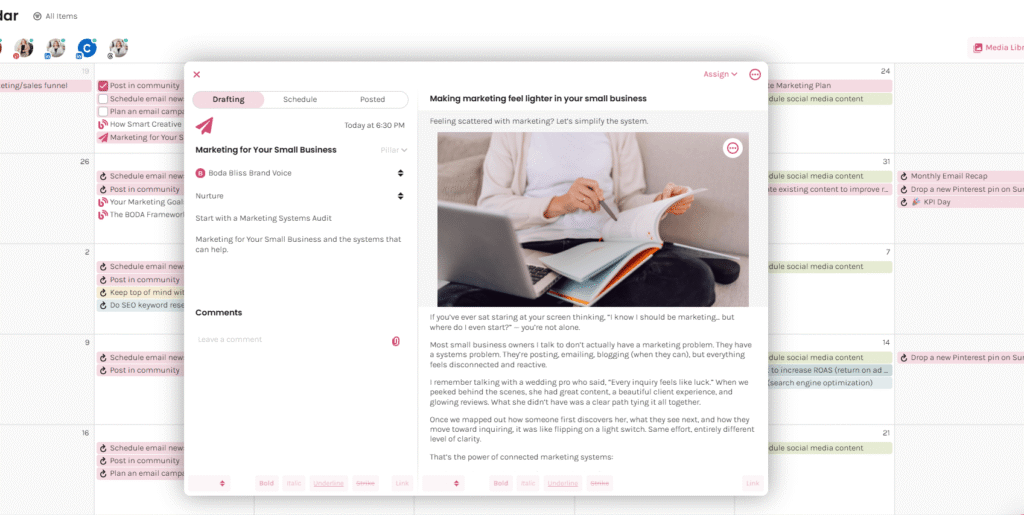
Finally, explore Enji’s built-in AI Copywriter.
Rather than replacing your creativity, it helps you overcome writer’s block by generating blog ideas, social captions, email drafts, and marketing copy using your brand voice as a guide.
I like to think of it as a brainstorming partner that helps me get started faster while allowing me to add the personality and expertise that make my content unique.
The setup process doesn’t have to be completed in one afternoon.
Instead, focus on building one piece of your marketing system at a time. Once you’ve completed the initial setup, the real value of Enji comes from using it consistently to plan campaigns, organize content, and measure your progress.
Conclusion: Getting Started with Enji Is Just the Beginning
Getting Started with Enji isn’t about learning another piece of software. It’s about creating a marketing system that helps your creative business grow consistently.
When I first tried Enji, I expected it to solve all of my marketing challenges. However, I quickly realized that software alone isn’t the answer. What finally changed everything wasn’t a new feature or a better dashboard. It was building a repeatable marketing system that connected my goals, campaigns, content, and marketing metrics in one place.
Today, Enji has become the marketing headquarters for my business, and I hope this guide helps you build the same kind of foundation for yours.
If you’re ready to get started but aren’t sure where to begin, I recommend starting with a Marketing Systems Audit. Together, we’ll evaluate your current marketing, identify gaps, and create a clear strategy before you begin setting up new tools.
Already have a marketing strategy but need help organizing everything inside Enji?
My Marketing Hub Setup service helps creative business owners build a customized marketing system, organize campaigns, connect the right tools, and create workflows that are easy to maintain long after the initial setup.
Remember, the goal isn’t to use every feature Enji offers. Instead, focus on building a system you’ll actually use. After all, consistent marketing will always outperform perfect marketing.
Key Takeaways
- Getting Started with Enji is easier when you begin with a clear marketing strategy.
- Build your marketing system before trying to use every feature.
- Organize your campaigns around business goals, not random tasks.
- Keep your marketing in one place to stay consistent.
- Review your marketing metrics regularly and adjust your strategy as your business grows.
- A simple, repeatable marketing system is more valuable than a complicated one you’ll never use.
Author’s Note (Updated for 2026)
This article was originally published as a follow-up to my first experience with Enji. It has been completely updated for 2026 to reflect how I use Enji today as the marketing headquarters for my business. In addition to expanding the guide for creative business owners, I’ve included my current setup process, practical marketing system strategies, and lessons learned after several years of using Enji to plan campaigns, organize content, and build consistent marketing workflows.


