AI Search Visibility: How Businesses Get Found
TLDR: AI search visibility drives recommendations. Clear messaging, content, trust signals, and consistent listings determine whether your business gets found or gets skipped.
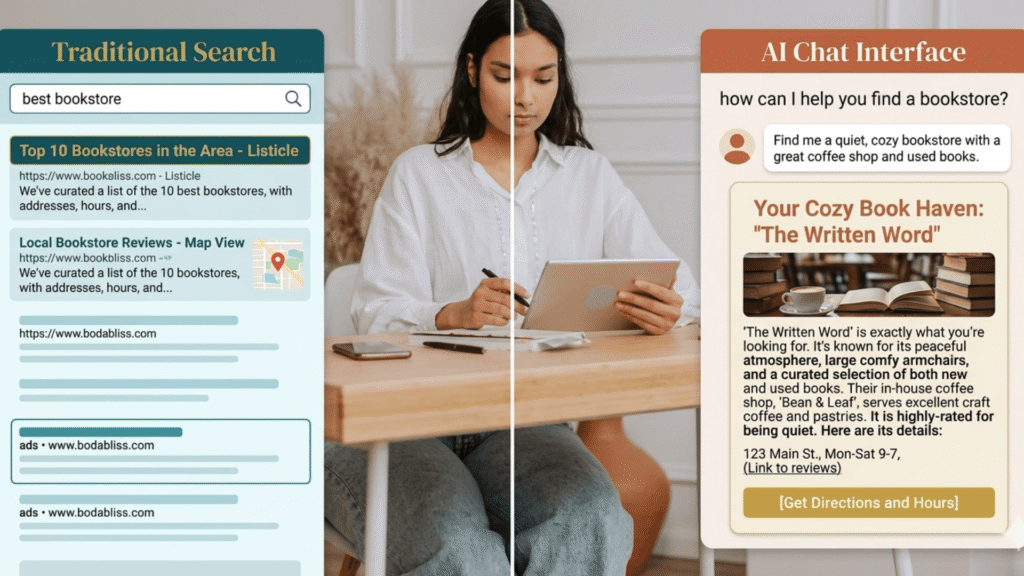
AI search visibility is changing how people find businesses, and if yours relies on inquiries, this shift is already affecting you. People are still using Google, but behavior is moving toward asking AI tools for direct answers. The real question is: is your business showing up in those answers?
In this post, you’ll learn:
- How AI is changing search
- What determines whether your business gets recommended
- Why strong businesses are still invisible
- What you can do to improve your visibility
How AI Is Changing Search Behavior
For years, visibility meant ranking on Google. Getting to page one felt like the goal.
But the way people search has changed, not just in where they search, but in how they ask questions. More and more people use tools like ChatGPT, Perplexity, and Gemini for research. They turn to these tools to find vendors, compare services, and get recommendations. Adobe’s research on how ChatGPT is being used as a search engine confirms that this shift is already well underway, with AI tools becoming a regular part of how people research and decide.
In fact, nearly half of consumers already use AI-powered search tools, and that number will keep growing as AI becomes a more natural part of how people make decisions.
Who Is Using AI Search and When
What makes this worth paying attention to is who uses these tools and when. ChatGPT currently holds a 62% desktop usage share, which suggests people prefer it in work mode or research mode, the same mindset your potential clients carry when they actively look for a business like yours. Source: First Page Sage. That is why AI search visibility matters for service-based businesses now, not later.
How AI Answers Work (And Why That Matters for You)
Search used to work like this: you typed a few words, got a list of links, clicked through a few, and made a decision.
AI search works differently. Instead of giving you a list, it reads across multiple sources and pulls together a direct answer. There are no links to sort through. You get an answer, sometimes with a short list of recommended businesses already included.
Why People Are Moving Away from Traditional Search
This shift is partly driven by frustration. About 40% of people who switched to AI tools cite frustration with clicking through multiple links just to find a single answer. In other words, they are looking for clarity, not more tabs to open. Source: Semrush As a result, if your business does not appear in that answer, you are not part of the conversation at all.
Think about queries like these:
- “Who are the best wedding photographers in Austin for a moody, editorial style?”
- “Where is an independent bookshop near me with a great event space?”
- “What wedding florists in Chicago specialize in garden-style arrangements?”
These are not keyword searches. They are questions that sound like something you would ask a friend. And AI tools answer them by pulling from everything they can find about your business online.
Search queries have moved from short phrases to full, specific questions. Therefore, your messaging needs to match how your clients actually talk about what they are looking for. If it does not, AI has a harder time connecting your business to the right searches.
Where AI Looks When It’s Building an Answer
Most people assume AI tools just pull from Google. The reality is more layered than that.
AI does not just look for words on your page. It scans your website, your reviews, local news mentions, and your social media to build a connected picture of your business, a web of relationships between your business name, your location, your services, and the sources that reference you. Source: Brandlume
When someone asks an AI tool for a recommendation, it is drawing from multiple places at once:
- Your website
- Blog content and published articles
- Online reviews
- Business directories and listings
- Press mentions, podcast features, and collaborations
- Social media profiles
Together, these sources create your digital footprint, the combined picture of your business across the internet.
A website alone is not enough anymore. AI is piecing together information from multiple sources to form an understanding of your business. If your messaging is inconsistent across those sources, different services listed on your website versus your Google profile, or a bio that describes your work differently on each platform, AI has to guess which version is accurate. That uncertainty makes you harder to recommend.
When everything aligns, that picture becomes clearer and your AI search visibility strengthens.
This is not about being everywhere. It is about being consistent wherever you do show up.
How AI Decides Whether to Recommend You
Here is something I see come up often when working with clients: the businesses showing up in AI results are not always the most experienced or the most talented. They are the ones that are easiest for AI to understand and confidently recommend.
AI is essentially asking one question about every business it considers: “Do I have enough clear, consistent information to recommend this business?”
To answer that question, it is looking for a few things.
Consistency across platforms. When your website, directory listings, and online mentions all reinforce the same message, the same services, the same location, the same specialty, your credibility increases. AI cross-references these sources to confirm that what it is reading is reliable. When they match, you become easier to recommend. When they do not, you become harder to place.
Trust signals from others. AI reads beyond your own website. Mentions of your business in blog posts, podcasts, features, and collaborations all contribute to how trustworthy your business appears, even when those mentions do not include a direct link back to your site. The more your business is referenced and validated across the web, the more authority it carries.
What your reviews say about you. AI does not just count your reviews. It reads them. It looks for repeated phrases, consistent feedback, and patterns in how people describe their experience with you. Your reviews reinforce your positioning and help AI understand what working with you is actually like.
Real, experience-based content. Generic content, the kind that could apply to any business in your industry, does not carry much weight. Specific content does. Case studies, client stories, process breakdowns, and detailed insights all signal that you have real experience behind what you are sharing.
If you are finding that your marketing looks active but inquiries are still inconsistent, the issue is often structural rather than effort-based. This post on why your marketing is not working breaks down that pattern in more detail.
Why Strong Businesses Are Still Invisible

One of the most common things I hear from business owners is: “I have been showing up consistently, but inquiries are still inconsistent.”
Often, the issue is not effort. It is how their online presence is structured. Poor AI search visibility is rarely about doing nothing. It is usually about doing things in a way that is harder for AI to interpret.
The Well-Designed Website Problem
A beautiful website builds trust with people who visit it. AI, however, does not experience your website the way a person does. It reads the words. If your messaging is vague, lots of beautiful language but not enough clarity about what you do, who you serve, and where you are located, AI cannot place you accurately.
For example, I worked with a wedding planner who had a stunning website. The copy was poetic and the photos were gorgeous. But she included almost no information about her specific services, her location, or what a client could expect when they reached out. From a human perspective, it felt aspirational. From an AI perspective, there was not enough information to recommend her for specific searches.
Missing Context and Content Gaps
If your website does not explain what you do in enough detail, AI fills in the gaps with uncertainty, or skips you entirely. This is especially common in creative businesses where the focus sits on visuals and feeling rather than specific, searchable language.
Inconsistent Information Across Platforms
If your Google Business Profile lists different services than your website, or your location is unclear, or your business name appears slightly different across directories, those inconsistencies create confusion. And confusion, in turn, lowers your visibility.
What You Can Do to Improve Your AI Search Visibility
The good news is that this is fixable. Furthermore, it does not require starting over. It requires getting clearer about what is already there.
Clarify Your Website Messaging First
Your website should clearly answer three questions: What do you do? Who do you help? Where are you located? These are not just branding decisions. They are AI search visibility signals. If someone reading your homepage is still not sure what you offer after 30 seconds, AI is not sure either.
Prioritize Clarity Over Length
Research shows that a local boutique with a clear FAQ page answering “What is your return policy for local pickups?” often outranks a massive retailer whose policy is buried thousands of words deep in a terms of service document. AI favors direct, helpful answers over volume. Source: Advertising Week The same logic applies to how you describe your services. Plain, specific language outperforms vague, impressive-sounding language every time.
Complete Your Google Business Profile
Your Google Business Profile is one of the most reliable data sources AI uses for local recommendations. It is structured, consistent, and Google-verified, exactly what AI looks for. Keep it updated with your current services, location, hours, and photos. This is one of the most direct steps you can take to improve your local AI search visibility.
Create Content That Answers Real Questions
Think about the questions your ideal clients actually ask, out loud, to a friend, or now to an AI tool. Write about those. Not just “here are my services” but “here is how to know if you need a wedding planner” or “here is what a florist consultation actually looks like.” This kind of content builds authority over time because it is specific and useful.
Build Visibility Beyond Your Website
Also look for opportunities to get your business mentioned in other places, directories relevant to your industry, guest blog features, podcast appearances, and local press. Each mention adds to the broader picture AI builds about your business.
Get Consistent Across All Platforms
Do an audit of everywhere your business appears online. Make sure your business name, location, services, and description stay consistent. This is especially important for wedding professionals, where vendor directories AI regularly pulls from may list your business in multiple places.
Encourage Detailed Reviews
A review that says “amazing photographer!” is nice. A review that says “Sarah captured our ceremony in a way that felt true to our personalities. She stayed calm under pressure and knew exactly how to work with our venue’s lighting” is, however, much more useful for AI search visibility. Encourage clients to be specific about what they loved and how they describe the experience.
What This Looks Like in Practice for Wedding Professionals
If you work in the wedding industry, this shift is already shaping how couples find vendors. Couples are going to AI tools and asking things like “Who are the best wedding planners in Denver for an intimate outdoor ceremony?” and getting a curated answer before they ever open a browser tab.
The planners, photographers, and florists showing up in those answers are not necessarily the busiest or the most awarded. They are the ones whose online presence is clear enough for AI to connect them to that specific search.
That means your specialty matters and it needs to be stated clearly. If you specialize in intimate elopements, that should be obvious on your website, in your Google profile, and in the way clients describe you in reviews. If you are a florist known for garden-style, seasonal arrangements in the Chicago area, that combination of details is what makes you findable for the right search.
AI search is not the only way people discover businesses. A strong strategy still accounts for multiple paths to visibility. This post on small business marketing strategy covers how to think about that broader picture.
How This Connects to Your Marketing System
AI search visibility is not a separate strategy from the rest of your marketing. It is part of the same system.
When your website is clear, your listings are consistent, and your content is specific and useful, you are not just improving how AI understands your business. You are improving how every potential client understands your business, regardless of how they found you.
At Boda Bliss, a lot of the work I do with clients starts with a Marketing Systems Audit, looking at where the gaps are between what a business owner thinks their marketing is communicating and what it is actually saying online. AI visibility issues almost always come up in that process because they are usually symptoms of the same root problem: inconsistent or unclear messaging across platforms.
If you are not sure where your gaps are, that is usually the right place to start.
See how a Marketing Systems Audit works
And if your broader marketing system needs a structural review, this guide on systemizing your business marketing is a helpful companion.
FAQ
AI search visibility is how easily your business is found and recommended by AI tools based on your messaging, presence, and trust signals.
GEO is the practice of optimizing your content and presence so AI tools can understand and recommend your business.
Yes. SEO and GEO work together. Local SEO is still essential for visibility.
Through clear messaging, consistent listings, strong content, and trust signals.
It reviews how your business appears across AI tools, identifies gaps, and creates a strategy for improvement.
Final Thoughts
The way people discover businesses has already changed. And for inquiry-based businesses, wedding professionals, creative service providers, boutique retailers, that change matters because visibility is directly connected to how new clients find you.
The businesses getting recommended are not always the best at what they do. They are the ones that are easiest to understand, easiest to verify, and easiest to recommend.
If you are not showing up, it is not random. It is an AI search visibility issue, and it is one you can fix by getting clearer and more consistent in how your business appears online.
The goal is not just to be seen. It is to be understood well enough that AI, and the people using it, can confidently choose you.
Cinthia Onines is the founder of Boda Bliss, a marketing systems business serving wedding professionals and creative small businesses. Boda Bliss helps businesses improve the systems behind their marketing so visibility turns into consistent inquiries and bookings.


