How to Choose the Right System Strategist for Your Business
TL;DR: A system strategist helps connect the moving parts of your business. If your marketing feels disconnected, a marketing systems strategist can turn effort into new leads now.

A system strategist helps you figure out how the moving parts of your business should work together. But not every system strategist focuses on the same part of a business — and that’s where a lot of business owners get stuck before they even start looking.
The real challenge usually comes down to clarity: are you trying to fix how your business runs, or how your business attracts customers?
If your day-to-day operations feel chaotic, your accounting needs structure, or your fulfillment process is leaking time, you probably need a systems strategist focused on operations.
In contrast, if your core operations are running smoothly but your lead generation, client messaging, and sales tech feel stagnant or disconnected, you need a marketing systems strategist.
This post will help you tell the difference, understand what each type of strategist actually does, and know exactly what to look for before you hire one.
What a System Strategist Actually Does
In practice, this usually isn’t about a lack of tools. Most small business owners don’t have a systems problem because they’re disorganized people. They have a systems problem because their business grew faster than their processes did. You added a CRM here, a content calendar there, a new inquiry form last spring, and at some point the pieces stopped talking to each other.
A system strategist’s job is to notice that, name it, and build a plan to fix it. A lot of this work actually starts with something pretty simple: mapping out how work moves through your business from start to finish, so you can see where things stall or fall apart before you touch a single tool.
If you’re trying to systemize your business, the goal isn’t to add more software or create a giant collection of SOPs. It’s to create a connected way of working that makes it easier to know what happens, when it happens, and what happens next. (If you want a deeper look at what this actually looks like in practice, I walk through it here: how to systemize your business’s marketing.)
Here’s what that actually looks like, starting with the operational side.
What Is a System Strategist?
A system strategist helps businesses understand how their tools, workflows, and processes work together so the business can run more efficiently. Specifically, this can include things like:
- Project and task management
- Accounting and invoicing
- Team communication and delegation
- Fulfillment or service delivery
- Standard operating procedures (SOPs)
If you feel like you’re constantly putting out fires just to keep the business functioning, a general systems strategist is likely the better fit. Their focus is internal: making the business easier to run.
What Does a Marketing Systems Strategist Do?
A marketing systems strategist looks at a narrower, but often more visible, part of the business: everything between “someone finds you” and “someone becomes a client.”
That includes how your marketing tools, content, and lead tracking work together, and how inquiries move through your inbox and CRM. Additionally, it means looking at whether your visibility efforts (social media, Pinterest, Google Business Profile, AI search results) are actually converting into booked clients.
This is where I work as a Marketing Systems Architect.
I look at the system behind your marketing: how people find you, what happens when they become interested, how their inquiry gets captured, and how your tools and workflows move them toward becoming a client.
My focus isn’t just on generating traffic or getting likes. It’s on building the marketing systems strategy that connects visibility, inquiries, and client management, so consistent marketing actually turns into consistent bookings.
If you’re posting regularly, showing up online, and still not seeing inquiries land the way they should, that’s usually a sign your marketing systems—not your marketing effort—need attention. (If you’re curious what this role actually involves day to day, I break it down more here: Marketing Systems Architect: What You Need to Know.)
Marketing Systems Architect vs. Traditional Marketing Consultant
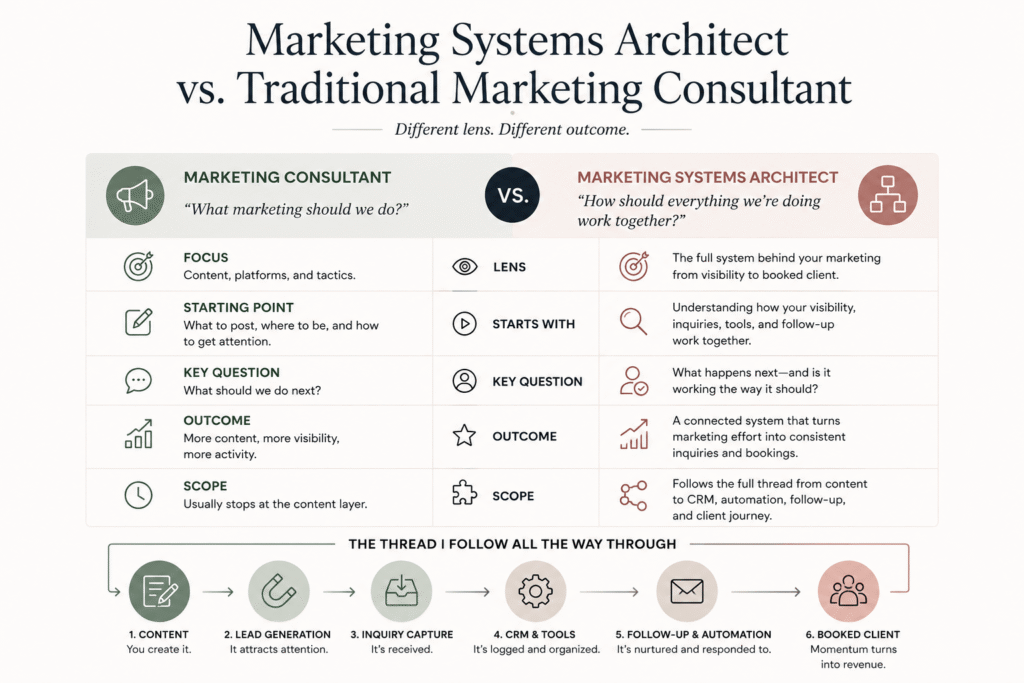
Honestly, plenty of marketing consultants and agencies do get into CRM setup, tech, and lead flow as part of their work — that overlap is real, and I don’t want to pretend otherwise. The real difference isn’t always the title on someone’s website. It’s the lens each person brings to your business:
Marketing consultant: What marketing should we do?
Marketing Systems Architect: How should everything we’re doing work together?
A lot of marketing advice stops at the content layer: what to post, which platforms to focus on, how to grow your following. That’s genuinely useful stuff. However, it doesn’t always follow through to what happens after someone sees your post.
What I do as a Marketing Systems Architect is follow that thread all the way through. It isn’t just, “What should you post next?” The bigger question is, “Okay, someone actually responded to that post. Now what?” Does your CRM catch the inquiry? Is your follow-up happening automatically, or are you doing it by hand at 10pm? Most importantly, does the momentum you just created turn into a booking, or does it fizzle out somewhere in between?
That means looking at, for example:
- How your content connects to your lead generation
- How inquiries flow into your CRM
- Whether your marketing tools are set up to support the client journey, not just create content
- How automation and workflows support (or slow down) your response time
A marketing systems strategy treats marketing as infrastructure, not just output. You don’t need to do more marketing. You need to connect what you’re already doing so each piece supports the next.
Signs You Need a Marketing Systems Strategist
You’re probably a good fit for this kind of support if you recognize yourself in a few of these:
- You’re posting consistently but inquiries are inconsistent or unpredictable
- Your CRM (HoneyBook, Dubsado, or otherwise) is half set up, or you’re not using it the way it was designed
- You’re manually responding to every single inquiry instead of using workflows or automation
- Your marketing tools, content planning, and lead tracking all live in different places with no clear connection between them
- You’re getting website traffic, but it’s not translating into inquiries
- You’re not sure how (or if) your business shows up in AI-powered search tools like ChatGPT, Gemini, or Copilot
If any of that sounds familiar, the issue usually isn’t a lack of effort. It’s a lack of systems connecting the effort to a result.
Which Type of Strategist Do You Need?
To make this even simpler, here’s a quick way to sort it out:
If your business is hard to run, you may need an operations-focused system strategist. This could be the right fit if you’re buried in admin, fulfillment, or day-to-day operations.
When you’re unsure what marketing to do, a marketing strategist may be the better choice. They can help you decide which platforms to focus on, what to say, and how to reach the right audience.
For businesses that are already marketing consistently, a marketing systems strategist can help when the pieces aren’t connecting. Your content may be going out, but the inquiries aren’t following.
If you need someone to look at your entire marketing ecosystem, that’s where a Marketing Systems Architect comes in. They look at visibility, inquiries, your CRM, and follow-up to build the infrastructure behind your marketing.
What a Marketing Systems Strategist Can Help You Systemize

A good marketing systems strategist looks beyond one part of your marketing. They consider how each piece supports the next.
That typically includes:
- Marketing tools: Make sure the platforms you’re paying for work together. Avoid disconnected tools that create more work.
- Content: Organize what you create so it supports your funnel. Give readers a clear next step.
- Marketing workflows: Build repeatable processes for content creation, publishing, and follow-up. This keeps you from starting over every week.
- Lead and inquiry flow: Map what happens when someone reaches out. Keep inquiries from falling through the cracks.
- Client journey: Look at the experience from first touchpoint to booked client. Connect what happens across every channel someone touches along the way. This helps your marketing and client management systems work together. (I go into what a strong first impression actually looks like here: The Client Onboarding Experience.)
- Automation: Find repetitive tasks you can automate. Automated workflows can handle many manual tasks. This includes follow-up after forms, email clicks, or page visits.
- Visibility: Make sure people can discover your business where they search. This includes traditional search, Pinterest, and AI-powered search tools.
How to Choose the Right System Strategist
Once you know which type of strategist you need, the next step is finding the right person. A few questions can help you evaluate your options.
Do they understand your business? Look for a strategist who understands service based, inquiry driven, and relationship focused businesses. That experience can reveal nuances a generic approach may miss.
Do they look at the whole system? Be cautious of anyone who jumps straight into a rebrand, new website, or content calendar. They should first understand how your current systems work together.
Can they work with your existing marketing tools? You shouldn’t have to tear everything down and start over. A strong strategist will assess what you already have. They can then improve it before recommending replacements.
Do they diagnose before they recommend? A strategist should ask questions about your current process before proposing solutions. Otherwise, they may be working from a template instead of your actual business.
Can they connect strategy and implementation? Strategy without implementation is just a document. Look for someone who can help you plan the system and put it into practice.
Why a Marketing Audit Should Come Before Changing Everything
When things feel disconnected, rebuilding everything can seem tempting. You might consider a new website, CRM, content plan, or all three. In practice, this approach often creates more overwhelm.
To be upfront, a formal paid audit isn’t the only way to get clarity. Some business owners can identify problems on their own. What matters is finding the problems before rebuilding.
Jumping straight to new tools or a new plan can lead to unnecessary expenses.
Start by understanding what’s actually broken.
A marketing systems audit helps you find those disconnects before rebuilding. It identifies where your inquiry flow breaks down. That could happen in your visibility, content, CRM, or the handoff between them.
Curious what that looks like? Here’s what a marketing audit reveals about your business.
An audit also gives you a more targeted starting point. You can make intentional changes instead of rebuilding based on assumptions. This approach can also reduce cost, time, and disruption.
How Boda Bliss Approaches Marketing Systems Strategy
At Boda Bliss, I work with wedding professionals and creative small businesses.
My clients include planners, photographers, venues, florists, stationery shops, and independent bookstores.
They are doing the marketing work but aren’t seeing consistent bookings.
My approach starts by looking at how your visibility, inquiries, and client management connect.
From there, I can identify gaps before recommending new tools or more content.
Whenever possible, we build your marketing systems strategy around the tools you already have.
There’s no need to start over when your current tools can do the job.
The goal isn’t more marketing. It’s a marketing ecosystem where what you’re already doing works harder for you.
Frequently Asked Questions About Marketing Systems Strategy
A general systems strategist focuses on internal operations. They look at how your business runs day to day. A marketing systems strategist focuses on your visibility, inquiries, and client management. Their goal is to connect those pieces so they support consistent bookings.
A Marketing Systems Architect looks at the full system behind your marketing. That includes how people find you and what happens after they show interest. They also look at how inquiries get captured and how your tools and workflows move people toward becoming clients.
The focus isn’t simply creating more content. Instead, the goal is to connect what you’re already doing.
A marketing systems strategy creates a plan for your visibility, content, CRM, and follow up. Each piece should support the next. The goal is to turn consistent marketing effort into more consistent inquiries and bookings.
Not necessarily. A good marketing systems strategist will first assess what you’re already using. That might include HoneyBook or Dubsado. They can then improve or reconfigure your existing setup before recommending a replacement.
Start by looking at where the problem occurs. If people aren’t finding you or submitting inquiries, you likely have a marketing systems issue. When inquiries come in but daily operations feel overwhelming, you may need operations support instead.
A marketing systems audit reviews how people find your business. It also looks at your content, marketing tools, and inquiry to booking process. The goal is to identify where those pieces break down.
The timeline depends on what’s broken. Some fixes can show results quickly. For example, you might turn on an auto-reply in HoneyBook or Dubsado. You could also fix a contact form that wasn’t working.
Ready to See What’s Breaking Your Inquiry Flow?
If you’re posting consistently but your inquiries still feel unpredictable, a Marketing Systems Audit is a clear place to start.
The audit shows you where your visibility, content, and CRM are disconnected. You’ll know what to fix first instead of guessing.
Book your Marketing Systems Audit →
Originally published in 2024, this article has been updated for 2026 with refreshed examples, updated terminology, and a new focus on marketing systems strategy.
About the Author
Cinthia Onines is the founder of Boda Bliss and a Marketing Systems Architect who helps creative small businesses and wedding professionals make their marketing work like a system, not a collection of disconnected tasks.
With a background in wedding planning and years of experience working behind the scenes of service-based businesses, Cinthia understands what happens when marketing tools, content, inquiries, and client management don’t quite connect.
Today, she helps business owners build clearer marketing systems that connect visibility, workflows, tools, and client journeys so their marketing can turn into consistent inquiries and bookings.


