AI Search Optimization for Wedding Professionals
TL;DR: AI Search Optimization helps wedding professionals get recommended in ChatGPT, Gemini, and Google AI Overviews so more couples can discover their business.
AI Search Optimization is quickly becoming one of the most important marketing strategies for wedding professionals. Couples are no longer relying solely on Google to find photographers, planners, florists, and venues. Instead, they’re opening ChatGPT, Gemini, Perplexity, and Google AI Overviews and asking questions like:
- “Who are the best wedding photographers in Chicago?”
- “Recommend a documentary-style wedding photographer near me.”
- “Find a wedding planner who specializes in multicultural weddings.”
If your business isn’t showing up in those answers, you’re becoming invisible to a growing number of potential clients. Couples are increasingly using AI to research vendors, compare options, and narrow their shortlist before they ever visit a website.
After working with wedding professionals for nearly a decade, I’ve seen how quickly couples’ research habits evolve. AI search is simply the next shift, and businesses that adapt now will have an advantage over those waiting for it to become mainstream.
Marketing and AI Has Entered a New Era
For the past few years, marketing and AI conversations focused almost entirely on creating content faster.
People asked questions like:
How can AI write my Instagram captions? Can ChatGPT write my blogs? Should I use AI for emails?
Those are still useful tools.
But the bigger shift isn’t what AI can create.
It’s how AI helps people search.
Instead of scrolling through ten pages of Google results, couples can simply ask an AI assistant for recommendations. That means visibility now depends on whether AI understands your business well enough to recommend you.
How Couples Search for Wedding Vendors With AI
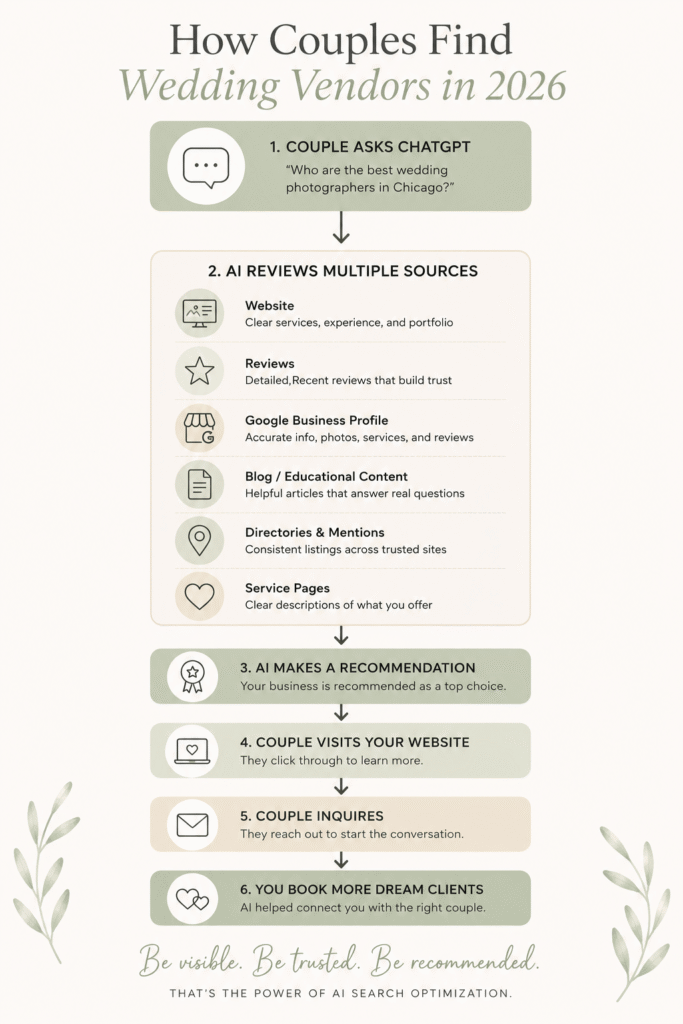
Real searches look more like conversations than keywords.
Examples include:
“Who should I hire for a luxury wedding in Wisconsin?” “Best wedding venue for 150 guests with outdoor ceremony.” “Affordable wedding florist near Naperville.” “Wedding planner experienced with multicultural weddings.”
AI combines information from multiple sources. It looks at your website, reviews, directories, structured data, and other trusted sources before generating an answer. If your website doesn’t clearly communicate what you do and who you serve, AI has very little confidence recommending you.
How Do I Show Up When Someone Asks AI Who to Hire?
This is the question every wedding business should be asking.
The answer isn’t about tricking ChatGPT or stuffing more keywords onto your website.
It’s about giving AI enough clear, trustworthy information to confidently recommend your business.
AI looks for signals like:
- Clear service descriptions that explain exactly what you offer.
- Helpful educational content that answers couples’ questions.
- Location-specific information so AI knows where you work.
- Strong service pages that explain your process and expertise.
- Detailed client reviews that mention your services and experience.
- Consistent business information across your website, Google Business Profile, and online directories.
If you’re unsure whether your website is sending the right signals, a Marketing Systems Audit can identify the gaps before you invest more time in content or SEO.
Think of AI as reading your entire online reputation instead of just one webpage.
It considers your website, reviews, directory listings, business profile, articles, and other trusted sources to determine whether your business is credible enough to recommend. The more consistent and complete that information is, the easier it is for AI to understand who you serve and when to recommend you.
Each AI platform weighs these signals a little differently. If you’d like a deeper look at how ChatGPT, Gemini, Claude, and Perplexity evaluate local businesses, read my guide comparing the major AI search platforms.
Answer Engine Optimization vs. Traditional SEO for Wedding Businesses
Traditional SEO is about helping your webpages rank in search results.
Answer Engine Optimization (AEO) is about helping your business become the answer.
Here’s the difference:
| Traditional SEO | AI Search Optimization |
|---|---|
| Rank webpages | Become the recommendation |
| Focus on keywords | Focus on questions |
| Google Search | ChatGPT, Gemini, Perplexity & Google AI Overviews |
| Clicks | Recommendations |
| One webpage | Entire online presence |
Instead of optimizing only for keywords like “Wedding planner Chicago,” you also optimize for the questions couples naturally ask AI.
For example:
- Who is the best wedding planner for an intimate wedding?
- How much does a wedding planner cost?
- What questions should I ask before hiring a photographer?
- Who are the best wedding venues near me?
AI tools are designed to answer questions, not just match keywords. The businesses that provide clear, direct, and trustworthy answers are more likely to be recommended.
The same approach also improves your visibility in Google AI Overviews. When your content clearly answers common questions, Google is more likely to use it when generating AI-powered summaries at the top of search results. That’s why optimizing for AI search and Google AI Overviews often goes hand in hand.
If you’re wondering whether this is a passing trend, Google has made it clear that generative AI is becoming a core part of how search works, making Answer Engine Optimization an increasingly important part of modern SEO.
7 Ways to Improve Your AI Search Visibility Today

The good news is that you don’t have to overhaul your entire marketing strategy. Small, intentional improvements can make it easier for AI tools to understand and recommend your business.
Here are seven places to start:
1. Clearly Define Your Services
First, be specific about what you offer and who you serve. Instead of broad descriptions, explain your specialties, ideal clients, and the types of weddings you love to work on.
2. Add Location-Specific Information
Next, make it easy for AI to connect your business with local searches. Mention the cities, regions, and venues you regularly serve throughout your website.
3. Answer Your Clients’ Most Common Questions
Then, think about the questions couples ask during consultations. Those same questions are increasingly being typed into ChatGPT, Gemini, and Google AI Overviews. Creating content that answers them builds trust with both potential clients and AI search tools.
4. Collect Detailed Client Reviews
Don’t stop at five-star ratings. Encourage clients to mention specific details about your experience, communication, style, and the services you provided. Those details help AI better understand your expertise.
5. Keep Your Business Information Consistent
Your business name, services, contact information, and messaging should match across your website, Google Business Profile, directories, and social media.
Remember, consistency isn’t a one-time project. It’s an ongoing part of maintaining your online presence.
6. Publish Helpful Educational Content
Instead of creating content just to stay active on social media, focus on answering real questions your ideal couples are already asking. Helpful, educational content builds the trust signals AI systems look for.
7. Use Structured Data (Schema Markup)
Finally, consider adding Schema markup to your website. While it doesn’t guarantee you’ll appear in AI-generated answers, it helps search engines better understand your content and increases the clarity of your website for both traditional search and AI-powered search experiences.
Why Wedding Businesses Need AI Search Optimization
The shift to AI search isn’t something that’s coming in the future. It’s already happening.
According to The Knot Worldwide’s 2026 Real Weddings Study, AI adoption among engaged couples nearly doubled year over year, reaching 36%. Couples are using AI to gather inspiration, answer planning questions, compare vendors, and narrow their options before making their final decisions.
Unfortunately, most individual wedding businesses aren’t showing up in those conversations.
According to the 5W Wedding Industry AI Visibility Index 2026, approximately 84% of individual wedding vendors have effectively zero AI citation share. Instead, AI-generated recommendations are dominated by major wedding platforms like The Knot, WeddingWire, and Zola, which collectively account for approximately 73% of wedding-planning AI responses. That means many couples are discovering platforms before they ever see an individual wedding business.
The Future of Wedding Marketing Isn’t More Content
Many wedding professionals assume they simply need to publish more content.
In reality, that’s only part of the picture.
You don’t necessarily need:
- More Instagram posts
- More TikToks
- More blogs
Instead, you need content that:
- Answers real client questions.
- Demonstrates your expertise.
- Builds trust.
- Helps AI clearly understand who you serve.
That’s the foundation of AI Search Optimization.
Most importantly, AI search isn’t replacing traditional search engines. It’s changing how couples discover businesses in the first place.
They still want experienced wedding professionals. They’re simply using AI to narrow their shortlist before they ever visit a website.
The wedding businesses that communicate their expertise clearly, maintain a consistent online presence, and create genuinely helpful content today will be in the strongest position as AI-powered search continues to evolve.
Frequently Asked Questions About AI Search Optimization for Wedding Professionals
AI Search Optimization is the process of helping AI tools like ChatGPT, Gemini, and Google AI Overviews understand and recommend your business.
Answer Engine Optimization (AEO) is the practice of creating content that directly answers the questions people ask AI tools and search engines.
Wedding vendors appear in ChatGPT by having clear website content, detailed reviews, consistent business information, and a trustworthy online presence.
Yes. More engaged couples are using AI tools to research vendors, compare options, and narrow their shortlist before booking.
SEO helps your website rank in search results. AI Search Optimization helps your business become the recommendation in AI-generated answers.
Create helpful content that answers common questions, clearly describe your services, use structured data, and keep your business information consistent across the web.
The best solution is improving your AI visibility through clear website content, consistent business information, strong reviews, and an AI Search Optimization strategy.
No. AI Search Optimization complements traditional SEO by helping AI understand and recommend your business while SEO continues to improve your search rankings.
Find Out How Visible Your Wedding Business Is in AI Search
The AI Search Visibility Roadmap shows you exactly how ChatGPT, Gemini, and other AI search tools currently understand your business, where visibility gaps exist, and what to improve first so you can increase your chances of being recommended.
Whether you’re a wedding planner, photographer, florist, venue, or another wedding professional, you’ll leave with practical next steps to improve your visibility where couples are increasingly searching.
Get your AI Search Visibility Roadmap.
Key Takeaways
- AI Search Optimization helps your wedding business become a recommendation in AI tools like ChatGPT, Gemini, Perplexity, and Google AI Overviews.
- Couples are increasingly using AI to research wedding vendors before visiting websites or reaching out.
- AI evaluates your website, reviews, Google Business Profile, directory listings, and educational content to decide which businesses to recommend.
- Traditional SEO is still important, but Answer Engine Optimization (AEO) focuses on answering the questions couples ask AI.
- Creating clear service pages, earning detailed reviews, publishing helpful content, and keeping your business information consistent all improve your AI search visibility.
- Businesses that invest in AI Search Optimization today will be better positioned as AI continues to change how couples discover and choose wedding vendors.
Author’s Note (Updated for 2026)
When I first wrote this article, AI was mostly being used to create marketing content. Today, the conversation has shifted. Couples are now using AI to research and discover wedding vendors, which means visibility matters more than ever. I’ve completely updated this guide with current research and practical strategies to help wedding professionals prepare for the future of search.


