AI Visibility: How AI Search Finds Your Business
TL;DR: AI visibility is how easily AI search tools can find, understand, and accurately represent your business. Here’s what it means, why your Google Business Profile matters, and where to start improving your visibility.

AI visibility is changing how people find and evaluate businesses online. And that changes what your business needs to communicate.
A few years ago, someone looking for your business typed a couple of keywords into Google. Now they’re asking full questions to ChatGPT, Google AI Overviews, and AI Mode, and getting an answer instead of a list of links. Because of this, your business needs to be understood, not just found.
So, what does that actually mean for you? In short, AI visibility is about whether AI-powered search tools can find, understand, and accurately represent your business when someone asks a question that could lead to you. It’s related to SEO, but it’s not the same thing, and it depends on more than your website alone.
In this post, you’ll learn:
- What AI visibility actually means and how it’s different from traditional SEO
- How conversational search is changing what people expect from a search result
- Where AI tools actually pull information about your business from
- How AI search understands intent, not just keywords
- Why your Google Business Profile matters, and why it isn’t the whole picture
- Practical steps to start improving your AI visibility this week
What Does AI Visibility Mean for Small Businesses?
AI visibility is how easily AI systems can find, understand, and accurately represent your business.
It builds on many of the same fundamentals as SEO. Clear website copy, accurate business information, and a site that’s easy to crawl still matter. However, AI visibility looks beyond your website and rankings.
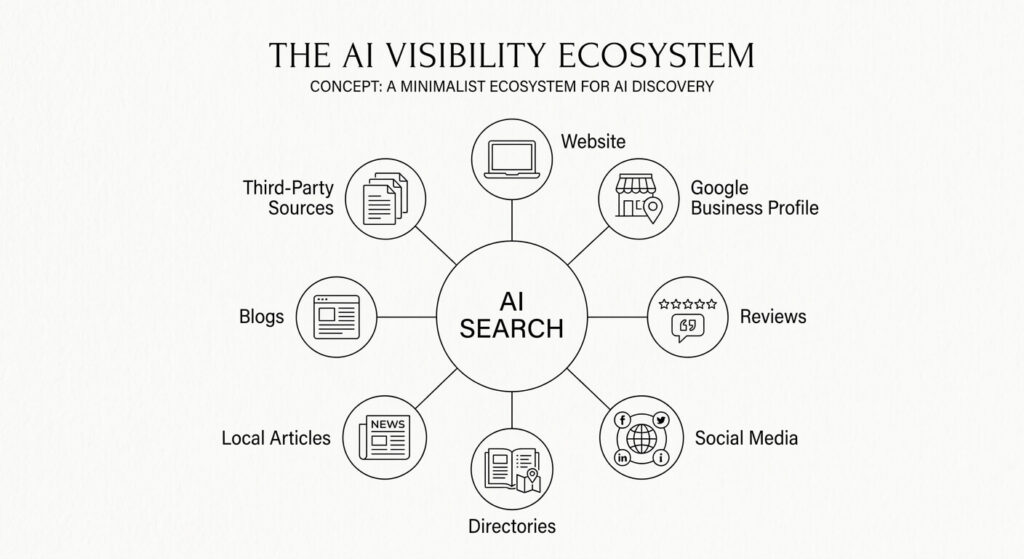
It considers the full picture of your business across your website, Google Business Profile, reviews, directories, social profiles, and other sources. The goal is to make sure those pieces provide enough clear, specific, and connected information for an AI system to understand your business accurately.
Put simply: SEO gets you found. AI visibility gets you understood.
You need both. One doesn’t automatically create the other. A business can rank well and still have gaps in how AI systems understand and represent it if its information is inconsistent or too thin across the sources they use.
That’s what makes AI visibility different from another item on your SEO checklist. It’s about how clearly your entire online presence communicates who you are, what you offer, and why you’re relevant to the people searching for you.
How Is AI Search Changing the Way People Find Businesses?

Here’s an example that makes this shift easy to see.
Traditional Keyword Search vs. Conversational AI Search
A traditional search might look like this:
“independent bookstore Chicago”
Short and general. The person gets a list of results and does the work of narrowing it down themselves.
A conversational search looks more like this:
“I’m looking for a cozy independent bookstore near me that stays open late, has coffee and cocktails, and has a good selection of gothic books.”
That single sentence packs in a lot of information:
- Location — near me
- Business type — independent bookstore
- Atmosphere — cozy
- Hours — stays open late
- Amenities — coffee and cocktails
- Product selection — gothic books
Because of this, the AI system now has to find a business that matches all six of those details, not just one keyword. That’s the real shift behind AI visibility. It isn’t about matching a word. It’s about understanding intent.
In practice, thin or generic information can make it harder for an AI system to determine whether your business fits a specific request, even if it would have been a perfect match. If nothing online confirms your late hours, your atmosphere, or your book selection, an AI system has no way to connect you to that request. On the other hand, a business with clear, specific information in the right places has a much better shot at being part of the answer.
Where Does AI Search Get Information About Your Business?
This is the part that surprises most business owners: AI search doesn’t just read your website.
It can draw information from several places, including:
- Your website
- Your Google Business Profile
- Reviews
- Directories
- Social media profiles
- Local publications
- Other third-party sources
- Publicly available information
However, not every AI system pulls from the same sources. According to Google’s documentation on optimizing for generative AI features, its generative Search features rely on core Search systems and indexed web content, and may use what’s known as query fan-out, running multiple related searches across subtopics. Google also recommends keeping your Business Profile information current, since that can help your business appear in AI-powered results.
ChatGPT works differently. When ChatGPT Search is enabled, it looks up information on the web and provides source citations, but that’s a separate system from Google Search or your Google Business Profile. Perplexity works in a similar way, searching the web in real time and synthesizing an answer with citations back to its sources.
In other words, different systems have different sources available to them. That’s exactly why your information needs to be clear and consistent everywhere, not just optimized for one platform. More importantly, this is also why chasing a single “AI ranking hack” rarely works the way people hope. There isn’t one system to optimize for. There’s an ecosystem of them, and each one is looking at a slightly different slice of what’s available online.
How Does AI Search Understand Search Intent Beyond Keywords?
It’s worth repeating, because it changes how you should think about your information. AI search isn’t simply looking for the word “bookstore” or “photographer” or “florist.” Instead, it’s trying to figure out which specific business best matches what a person actually wants.
As a result, specificity matters more now than it used to.
Vague information might be enough to match a broad keyword. It isn’t enough to clearly communicate whether your business fits a specific search.
For example, “wedding photographer” tells an AI system your category. It doesn’t tell the system whether you shoot elopements, whether you travel, what your style looks like, or what a couple can expect from working with you.
That’s the kind of detail that helps an AI system match your business to a specific, detailed request instead of a general one.
This is also where the different sources start to work together.
Your website might explain your process, while your Google Business Profile lists your service area and specific services. Customer reviews, meanwhile, can describe what past clients actually experienced. Each piece answers part of the question. Together, they give an AI system more context to accurately represent your business for a detailed search, not just a generic one.
Consider a florist who only serves weddings within a specific service area but never states that anywhere except in a consultation conversation. A general search for “florist” won’t reveal that gap.
A more detailed search, like “wedding florist who can deliver to a venue an hour outside the city,” will. If that specific piece of information doesn’t exist anywhere online, the florist is invisible to exactly the kind of request they’d actually want to win.
How Does Your Google Business Profile Support AI Visibility?
Your Google Business Profile is an important part of your AI visibility because it’s information you control directly, and it’s designed to describe your business.
A complete profile can communicate:
- What you do
- What you offer
- Where you are
- Who you serve
- What your business looks like
- What customers experience
- What’s currently happening in your business right now
A few features are worth a second look if you haven’t touched your profile in a while:
- Custom services, for anything that doesn’t fit Google’s predefined categories
- Specific service descriptions, so people know exactly what they’re booking
- Customer Q&A, since that section is public whether you’re active in it or not
- Original photography, showing your business as it actually looks today
- Current updates, so your profile reflects what’s happening right now, not six months ago
That last point deserves a little more explanation, because it’s one of the most overlooked parts of a profile. For example, updates can help communicate what’s happening in your business now: a seasonal offer, an upcoming event, a new service, holiday hours, or other timely information.
However, think of these updates as current context for anyone, human or AI, trying to understand your business today. They’re not a shortcut to better rankings. They’re simply another way of keeping your information accurate and current, which is the theme running through this entire list.
For the full 25-point breakdown, grab the Google Business Profile Checklist. This section is about why these features matter for AI visibility, not a repeat of the whole list.
Why Does Consistent Business Information Improve AI Visibility?
This is where things get more interesting than the usual “keep your listings consistent” advice.
Say a bookstore’s information looks like this:
- Google Business Profile: Bookstore
- Website: Independent bookstore specializing in used and rare books
- Reviews: “The best place in town for gothic fiction”
- Social media: Books, coffee, cocktails, and events
None of those statements contradict each other. Still, none of them tell the whole story on their own. Each one is a different piece of the same picture.
So the real question becomes: can a search system piece those together and understand what actually makes this business relevant to a specific search? That’s more useful to ask than whether your listings match word for word.
Try this for your own business:
- What does your Google Business Profile say about you?
- What does your website say?
- What do your reviews say?
- What do other sites or directories say?
- Are those things consistent with each other?
- Is anything important about your business missing everywhere online?
If you’re noticing gaps, you’ve just found a real AI visibility problem, and it’s likely bigger than one outdated listing. That’s not a bad thing to discover. It just means you now have a clearer starting point than guessing.
What Information Do Service Businesses vs. Product Businesses Need for AI Visibility?
Not every business needs to communicate the same things, since not every business is being evaluated for the same reasons.
Service businesses (planners, photographers, florists, rental companies) need to make clear:
- What you do
- Who you serve
- Where you work
- Your process and results
- Your team
The most useful photos show your actual work: process shots, finished projects, real events, real clients.
Product businesses (bookstores, stationery shops, boutique retail) need to make clear:
- What you sell
- What’s currently available
- What your store experience feels like
- Current offers and events
The most useful photos show your actual products, displays, and products in context.
If a service business is mostly showing product-style photos, or a product business is only showing portraits, the content may not be giving potential customers enough information about what they can actually buy, book, or experience. That’s not a marketing failure so much as a mismatch between what’s being shown and what the audience actually needs to decide. In practice, it’s worth taking ten minutes to scroll through your last twenty posts or photos and asking whether a stranger could tell, just from looking, what you actually sell or do.
How Can You Improve Your AI Visibility Starting Today?
You don’t need to overhaul everything at once. Here’s where to start.
- Start with your Google Business Profile. It’s the piece of your AI visibility you control most directly. Use the free Google Business Profile Checklist to work through it step by step.
- Check your website. Does it clearly explain what you do, who you serve, and where you work, in plain language?
- Read your reviews. What words do customers actually use to describe you? That language is often more useful than anything you’d write yourself.
- Look for inconsistencies. Compare your Google Business Profile, website, social profiles, and directory listings.
- Answer the questions people keep asking. If several customers ask the same question, that’s useful marketing information. It may belong on your Google Business Profile, your website, an FAQ, or a piece of content, so the next person can find the answer without having to ask. That one small habit connects a customer question to your profile, your website, and your content in a single, repeatable loop.
- Keep current information current. Hours, events, offers, and services should reflect today, not six months ago.
Want to go deeper? Read How AI Recommends Businesses next. You can also read Marketing and AI Consistency for a closer look at how consistent information affects your broader marketing ecosystem.
Is Your Google Business Profile Enough for AI Visibility?
Your Google Business Profile matters. It’s one of the clearest, most direct ways to tell people, and AI systems, what your business is about.
That said, it isn’t your entire AI visibility strategy. AI search can evaluate information across a whole ecosystem: your website, Google Business Profile, reviews, directories, social profiles, local mentions, and other third-party sources. Different AI systems pull from different pieces of that ecosystem, depending on how each one is built.
Your Google Business Profile is important. It just isn’t your entire AI visibility strategy.
Ultimately, visibility isn’t about one platform or one profile. It’s about making sure your business is clear, accurate, and connected everywhere someone, or some AI tool, might go looking for you. For more on this, read AI Search for Small Businesses.
Frequently Asked Questions About AI Visibility
AI visibility is how easily AI-powered search tools, like ChatGPT, Google AI Overviews, and Perplexity, can find, understand, and accurately represent your business in response to a search.
Traditional SEO focuses on ranking your website for specific keywords. AI visibility is broader. It looks at whether your business information across your website, Google Business Profile, reviews, and other sources is clear and consistent enough for AI systems to understand and represent you accurately.
Yes, it’s one important piece. Google has said that current Business Profile information can help your business appear in AI-powered results, but it works best alongside a consistent website, reviews, and other online information.
Yes. Improving your Google Business Profile, keeping your website and listings consistent, and using the language from your actual reviews are all free steps that make a real difference.
There isn’t a fixed timeline. It depends on your starting point, how many sources need updating, and how quickly those changes are reflected across the places where your business appears online. That’s why I recommend starting with the biggest gaps and inconsistencies you can identify, rather than trying to fix everything at once.
Start by making the information about your business clear, specific, accurate, and consistent. Your Google Business Profile is a good starting point, but also review your website, reviews, directories, social profiles, and other places your business appears online.
Key Takeaways on Improving Your AI Visibility
- AI visibility is about whether AI search tools can find, understand, and accurately represent your business, not just whether your website ranks.
- Conversational search means people are asking detailed questions, so specific information matters more than generic keywords.
- AI systems are trying to match intent, not just terms, which is why vague listings and descriptions tend to underperform.
- AI tools pull from many sources, including your website, Google Business Profile, reviews, directories, and social profiles, and not every tool uses the same sources.
- Your Google Business Profile is a direct, controllable way to improve your AI visibility, but it isn’t the whole strategy.
- Consistent, specific information across every place your business appears online is what actually builds AI visibility over time.
Start with the free Google Business Profile Checklist. It’s the fastest way to improve the piece of your AI visibility you already control.
Already know your Google Business Profile needs more than a quick cleanup? Explore the AI Search Visibility Roadmap for a broader look at how your business is represented across search and a prioritized plan for what to fix next.
Cinthia Onines is the founder of Boda Bliss and a Marketing Systems Architect who helps creative businesses and wedding professionals build marketing systems that support long-term visibility and growth. She specializes in marketing operations, AI Search Optimization, content systems, and workflow strategy, helping business owners create connected marketing that works for both people and AI.
Drawing on her background in the wedding industry and years of experience designing marketing systems, Cinthia translates complex marketing and AI concepts into practical strategies that business owners can confidently implement.
When she’s not mapping marketing systems or researching the latest AI search trends, you’ll usually find her reading historical fiction, visiting independent bookstores, or enjoying a quiet afternoon with coffee and her notebook.


