How AI Recommends Businesses: A Small Business Guide
TL;DR: AI Recommends Businesses explains how trust, reviews, helpful content, and consistent business information influence AI recommendations.

You’ve probably noticed AI search doesn’t play by the same rules as Google used to. Every platform gathers information differently. But here’s the thing — they’re all chasing the same goal. So, they want to recommend the business that’s the best match for your customer’s question.
So, understanding how each platform works can really help you build a stronger online presence and AI search visibility.
Here’s the good news: you don’t need a different strategy for Google, ChatGPT, Perplexity, and Claude. Instead, you need one connected marketing system that helps every AI platform understand your business.
Some AI platforms lean on business listings and maps. Meanwhile, others care more about reviews, trusted websites, or in-depth content. Either way, these signals help AI decide if your business is worth recommending.
Many of these signals already support your marketing strategy. In fact, a well-maintained website, consistent business info, helpful content, and authentic reviews don’t just boost your AI visibility. They also make for a better experience for your actual customers.
So let’s walk through how AI recommends businesses on each major platform. And more importantly, what you can do to show up more.
How Google Gemini and Google AI Mode Recommend Businesses
Google is a great place to start if you want to understand how AI recommends businesses. When people think AI search, Google usually comes to mind first. That makes sense, since Google Gemini and Google AI Mode connect to tools you already use daily. Think Google Search, Google Maps, and your Google Business Profile.
Google doesn’t rely on just one source, though. Instead, it pulls from multiple places to figure out who you are, what you offer, and whether you’re the right match.
According to Google Search Central’s guidance on AI features, Google’s AI leans on clear business info, trustworthy content, and strong local signals to find the best fit for a search.
Here are some of the signals that matter most:
- A complete and accurate Google Business Profile
- Consistent business information across the web
- Positive customer reviews that mention your services
- An up-to-date website with clear service pages
- Structured data that helps Google understand your content
- Google Maps and local relevance
- The Google Knowledge Graph, which ties your business info together
None of these signals work alone, though. Instead, they lean on each other.
For example, your Google Business Profile tells Google where you work and what you offer. Meanwhile, your website fills in the details. Reviews add real experiences. And structured data pulls it all together.
That’s why I always tell business owners to treat marketing like a connected system. The more these pieces work together, the more confidently Google can recommend you.
And honestly, none of this is new. It’s just the fundamentals, done well and done consistently. So, that’s good for your customers and your AI visibility.
How ChatGPT Search Finds Local Businesses
ChatGPT is a great example of how AI recommends businesses differently than Google. It takes a bit of a different approach than Google. Where Google leans on its own ecosystem, ChatGPT looks across multiple sources instead. Think listings, directories, reviews, and trusted websites.
According to BARKmedia’s guide to how AI search works for local businesses, ChatGPT often pulls from directories, online reviews, and local citations. That way, it’s checking whether your business is trustworthy and relevant.
Here’s what ChatGPT tends to look for:
- A complete Bing Places for Business profile
- Accurate business listings across online directories
- Consistent business information and local citations
- Customer reviews that describe your services and experience
- A website that clearly explains what you do and who you serve
None of this is unique to ChatGPT, by the way. Instead, these are the same trust signals that make customers feel confident choosing you in the first place.
That’s why consistency matters so much. When your website, Bing profile, directory listings, and reviews all tell the same story, ChatGPT can recommend you with confidence.
So, if you’ve already kept your info accurate and created helpful content, you’re most of the way there.
Claude Understands Business Expertise
Claude offers a good look at how AI recommends businesses based on expertise rather than volume. It rewards depth over volume. So, it’s not counting how much content you publish. Instead, it values content that clearly shows expertise and actually answers people’s questions.
That’s great news if you’re a small business showing up in AI search. You don’t need a hundred blog posts to build credibility. Instead, you just need content that genuinely helps the people you serve.
Here’s what Claude tends to value:
- Helpful educational blog posts
- Detailed service pages
- Frequently Asked Questions (FAQ) pages
- Case studies and client success stories
- Well-organized content that’s easy to read
None of these are shortcuts, really. They’re just examples of clear, helpful communication.
So, I always encourage business owners to write with people in mind first. When you answer real questions and share your expertise, you help your audience and AI platforms both understand what makes you different.
At the end of the day, the goal isn’t more content. Instead, it’s content that’s useful, trustworthy, and tied into the rest of your marketing system.
How Perplexity Evaluates Businesses
Perplexity works a bit like a research assistant. It shows exactly where its info comes from. Rather than relying on one source, it gathers info from across the web and cites it.
That means your reputation beyond your own website matters even more here.
Some of the signals it looks at:
- Editorial mentions and published articles
- Local news coverage
- Industry features and interviews
- Partnerships with trusted organizations
- Positive reviews across multiple platforms
- Educational content that demonstrates expertise
You don’t need to chase press coverage every week, though. Instead, think about building authority over time. That way, every guest article, partnership, or local feature adds another trusted source to your name.
Meanwhile, the same goes for your own content, too. Helpful blog posts and educational articles give people, and AI, more ways to understand your expertise.
So, the goal isn’t to be everywhere. It’s to build enough trust that AI can confidently point people your way.
What AI Looks for Before Recommending Your Business
The Trust Signals AI Uses to Evaluate Your Business
At the end of the day, how AI recommends businesses comes down to trust. By now, you’ve probably noticed every AI platform gathers info a bit differently. Google leans on its own ecosystem. Meanwhile, ChatGPT, Claude, and Perplexity pull from trusted sources across the web.
Even so, they all share one thing in common. Before recommending anyone, AI is really asking one question: can I trust this business enough to recommend it?
That’s why trust matters way more than trying to game an algorithm.
And here’s the encouraging part — none of these trust signals are new. Instead, they’re the same things that make your customers feel confident choosing you.
Clear service pages, consistent info, authentic reviews, and helpful content all tell one story together.
AI isn’t fixated on one ranking factor, either. Instead, it’s connecting all these signals to build confidence in you. So, the more consistent you are across your site and online presence, the easier it is for AI to understand who you help and why you’re worth recommending.
Also, whether you own a creative business or work in the wedding industry, your customers are already using AI to research and compare businesses before reaching out.
Take a look at the table below for some of the most common trust signals AI platforms use.
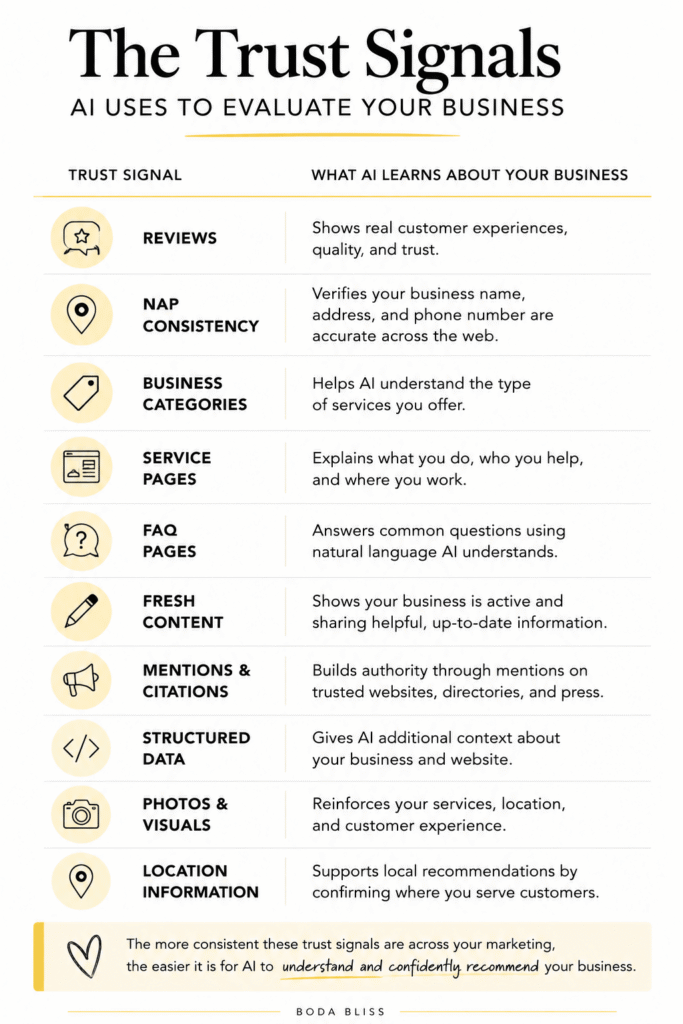
No platform publishes a perfect checklist. But they all reward businesses that are clear, consistent, and genuinely helpful. So, skip the quick wins. Instead, focus on building a solid foundation.
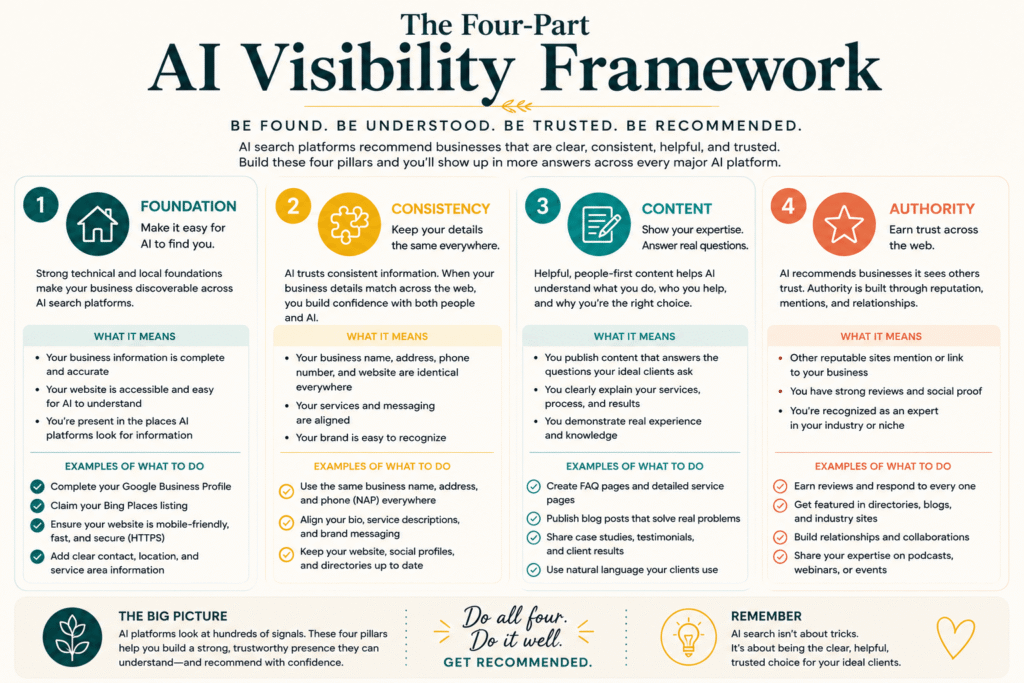
The Four-Part AI Visibility Framework
I’ve spent a lot of time researching how AI recommends businesses, and one pattern keeps showing up, no matter the platform.
That’s why I built what I call the Four-Part AI Visibility Framework:
- Foundation
- Consistency
- Content
- Authority
Together, these four pillars make it easier for people and AI to understand and trust you. So, in an upcoming guide, I’ll break down each one and show you how they work together.
Building a Business People and AI Can Trust
AI search is changing how people find businesses. But it’s not changing what makes a business worth recommending.
Throughout this guide, we’ve walked through how Google Gemini, Google AI Mode, ChatGPT, Claude, and Perplexity evaluate businesses. Each one gathers info differently. Even so, they all reward the same things: clarity, consistency, trust, and helpful content.
If there’s one thing to take away here, it’s this. You don’t need a whole new strategy for AI search. Instead, you just need a marketing strategy built for how people actually find businesses today — one that helps people and AI understand your business.
So, as you keep strengthening your presence, here’s what to remember:
- Build trust through clear, accurate, consistent business information.
- Create helpful content that answers the questions your customers already have.
- Keep your website, profiles, and reviews telling one connected story.
- Focus on being genuinely helpful, not chasing every algorithm update.
AI search will keep evolving, sure. But businesses built on trust and helpful content will always stand out.
So, if you’re ready to build a system that supports both your customers and your AI visibility, check out my Marketing Systems Services. Let’s build a stronger foundation together.
In the end, understanding how AI recommends businesses comes down to one simple idea. The businesses that succeed won’t necessarily be the loudest. Instead, they’ll be the ones that are easiest to understand, trust, and recommend.
Frequently Asked Questions About How AI Recommends Businesses
AI compares trust signals, reviews, business info, and content to find the best answer to your question.
Consistent info, helpful content, reviews, authority, and other trust signals across the web.
Yes! In fact, Google AI uses your Profile, Maps, reviews, and website to understand your business and support local recommendations.
Yes. ChatGPT uses sources like Bing Places, directories, reviews, and websites to recommend relevant local businesses.
Absolutely. Your website helps AI understand your services and who you help. So, that means better recommendations for you.
Nope. It builds on SEO instead. Strong SEO helps AI find you, while trust signals help it recommend you.


